

Many large organizations still rely on IBM i for critical operations. The platform is known for its stability. It rarely fails. But the applications running on it are often decades old.
Most of this code was written using fixed-format RPG. It follows strict column rules and is difficult to read for newer developers. When teams struggle to understand the code, fixing issues and adding features becomes slow.
This guide is meant to show that a full rebuild is not the only path. You can improve what you already have and make it work for current needs.
What is RPG Modernization?
RPG modernization is the process of updating legacy RPG applications on IBM i (AS/400) to meet today's business and technology demands without replacing the core business system. Rather than starting from scratch, businesses modernize their existing RPG code to improve performance, usability, and integration with modern platforms while effectively reducing technical debt.
Some of the key areas under RPG modernization include free-format RPG conversion, green screen to web UI, API and web service integration, SQL and Db2 modernization, and cloud and ERP integration.
The Real Cost of Doing Nothing
Your IBM i system holds thirty years of custom rules. This system is stable but it is now a black box.
The logic inside your RPG code is very old. Few people alive understand how it was built. This creates a big business risk. When you need to change a process or launch a product, the legacy code stops you. What should take days takes months. This bottleneck slows down your entire company.
The Talent Crisis is Here
Retirement is the biggest threat to your business. The programmers who built your core logic are leaving the workforce. No new generation of experts is coming to take their place.
When your last RPG expert retires, they take your company’s history with them. You cannot hire a modern developer to fix a system they cannot read. This leaves you in a dangerous spot. You own a system you can no longer control or change.
Why Big Migrations Fail
Leaders often think about ripping out the whole system. They want to move to a new cloud platform all at once. This is a huge gamble. The risk of losing data or stopping your business for weeks is too high.
This creates a trap. You cannot stay still because you are too slow. You are afraid to move because the risk of failure is too high. Modernization is the middle path. It lets you move your business logic into the modern world in small and safe steps. You get the speed of a new system without the risk of a total shutdown.
The History and Evolution of RPG
RPG is one of the oldest computer languages still used today. It started in 1959. Back then, it was just a tool to make printed reports. This is where the name comes from: Report Program Generator. It was not a full language yet. It just helped businesses print data from their machines.
From Punch Cards to Green Screens
In the early days, programmers used punch cards. They had to put code in exact columns. If a letter was one space off, the whole program failed. This is why we call it "fixed-format." Everything had a specific place it had to stay.
When the AS/400 came out in 1988, RPG III became the standard. This created the era of the "Green Screen." Programmers wrote code in a rigid grid. This worked for a long time, but it built a wall between RPG and modern tech.
The Major Versions of RPG Programming
To see how your system has changed, look at this table. It shows the move from the old way to the new way.
| Era | Version | Style | Status Today |
|---|---|---|---|
| 1970s | RPG II | Punch Cards | Outdated. |
| 1980s | RPG III | Column-Based | Legacy. Hard to manage. |
| 1994 | RPG IV | Mixed Style | Common. Most systems are here. |
| 2013+ | Free-Form RPG | Modern Text | Target. The best way to write. |
The Move to Free-Form RPG
IBM made a big change in 2013. They released Free-Form RPG. This changed the rules. Before this, RPG looked like a secret code. Only a few experts could read it.
With Free-Form, RPG looks like modern languages such as Java or Python. You do not have to worry about columns anymore. You can use long names for your data. You can also indent your code to make it easy to follow.
Why this History Matters
If your code is still in the RPG III style, your business is stuck in the 1980s. You cannot easily connect to the web. You cannot use AI tools. Moving to Free-Form RPG is like translating an old book into a language everyone speaks. It lets new developers join your team and start working fast.
Key Characteristics of Legacy RPG Applications
You can check your own system for these traits. These technical red flags show your IBM i is falling behind. These features make it hard to grow and expensive to run, signaling a critical need for legacy transformation.
Fixed-Format Code Structure
Fixed-format code is the old way of writing RPG. It requires every letter to be in a specific column on the screen.
- The Problem: Modern developers do not use columns. They use free-flowing text. Because fixed-format is rigid, new hires cannot read it.
- The Consequence: You depend on a small number of senior developers. When they leave, no one else knows how to manage your business rules, stalling your IBM i transformation efforts.
Business Logic Mixed with UI
In old RPG programs, the rules of your business and the screens the users see are the same piece of code.
- The Problem: If you want to change how a screen looks, you have to touch the math and logic behind it. This is called tight coupling.
- The Consequence: Small visual updates become risky. You might break a calculation just by moving a button on a screen.
Green Screen (5250) Interfaces
The 5250 interface is the classic black-and-green text screen. It relies on function keys like F1 or F24 instead of mouse clicks.
- The Problem: These screens are not easy to learn. They do not work like the web or mobile apps your employees use at home.
- The Consequence: Training new staff takes weeks. Users work slower because they have to memorize keystrokes instead of using a modern mouse or touch screen.
Tight Database Connection
In monolithic legacy applications, the program and the database are joined together. If you change a field in the database, every program using it might crash.
- The Problem: You cannot update your data structure without a massive rewrite of your entire system.
- The Consequence: Your data stays in old formats. This makes it hard to use modern tools for reports or data science.
No Native API Layer
Modern software talks to other apps using APIs. Legacy RPG was built to be a closed system, which is a major roadblock in legacy transformation.
- The Problem: There is no easy way for your IBM i to talk to Salesforce or a web shop in real-time.
- The Consequence: You use slow batch updates or manual data entry. This creates delays and leads to errors in your records.
Missing Documentation
Many RPG systems were built over thirty years. The people who wrote them did not write down how the programs work.
- The Problem: The manual for your business lives in the heads of your staff.
- The Consequence: You are one retirement away from losing the knowledge of your core processes. Researching one program can take a developer days of digging through old code.
Proprietary Environment
Legacy RPG runs in its own world. It uses special file types and unique ways of handling users.
- The Problem: Your IBM i team sits in a silo. They use different tools than your web or cloud teams.
- The Consequence: Your IT department is split. This lack of teamwork makes it hard to finish large projects and achieve a complete IBM i transformation.
Why RPG Modernization Is Urgent Now
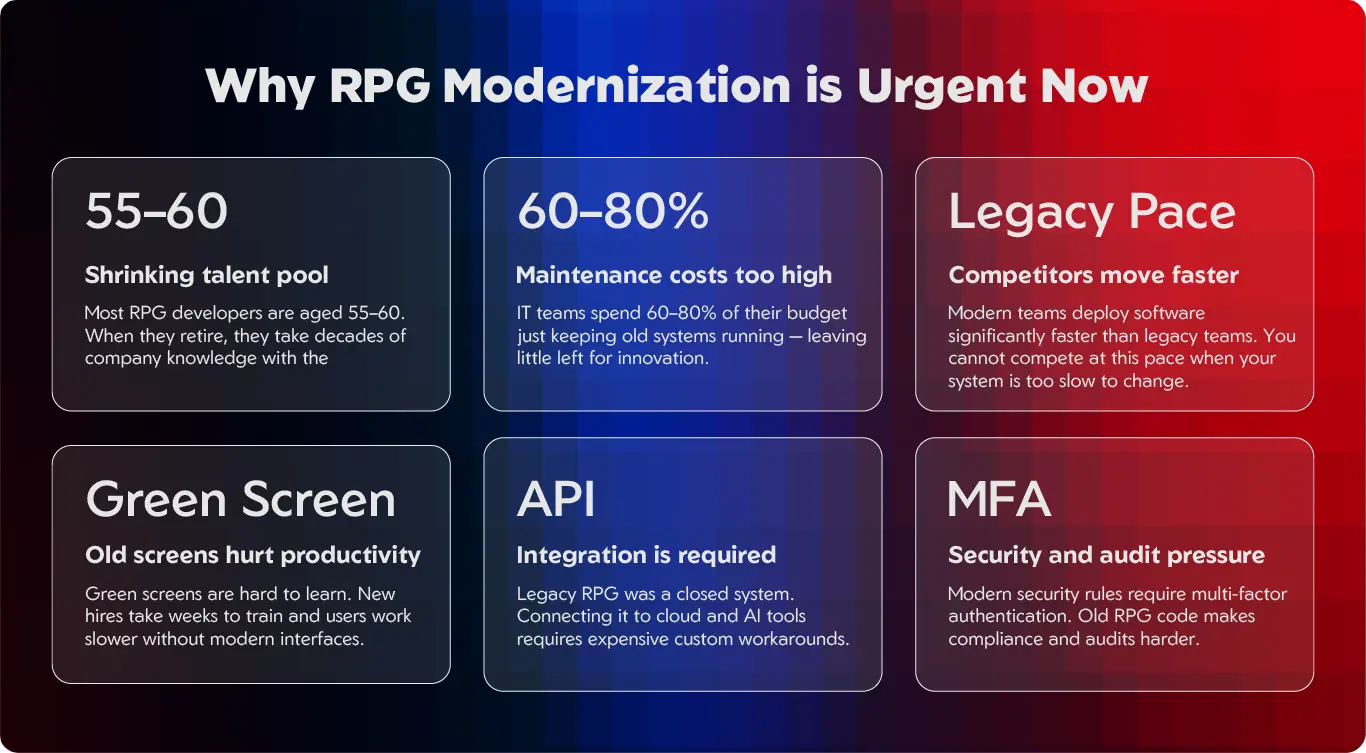
Updating your IBM i is a business necessity. If you wait, the risks and costs grow. Legacy RPG systems often limit change, require more maintenance, and slow integrate with newer platforms. RPG Application modernization guarantees that these systems continue to be dependable while meeting the demands of modern business and technology.
Here are six reasons you should act today.
1. The Talent Pool Is Shrinking
The people who know your system are retiring. Most RPG developers are 55 to 60 years old. When they leave, they take your company knowledge with them. Modernizing to a language like Java gives you access to 9 million developers. This keeps your business safe for the future.
2. Maintenance Costs Are Too High
IT teams spend 60% to 80% of their budget just to keep old systems running. This leaves very little money for new ideas. High maintenance costs stop you from beating your competitors. Modernizing lowers these costs so you can build new features.
3. Your Competitors Are Faster
Modern teams can launch new software faster than legacy teams. While you spend weeks changing one program, your competitors launch updates in days. You cannot keep up with the market if your system is too slow to change, making digital transformation on IBM i a competitive necessity.
4. Old Screens Hurt Productivity
Green screens are hard to use. They are also hard to teach to new hires. Research shows that better software design can give a huge return on investment. New workers want tools that work like a web browser. When you use old screens, training takes longer and staff get frustrated.
5. Integration Is Required
Your IBM i must talk to the cloud and AI tools to stay useful. Modern business needs data to move fast through APIs. Monolithic legacy applications was built as a closed system. Connecting it to new tools requires expensive custom work. Modernizing lets your data flow freely.
6. Security and Audit Pressure
Security rules change every year. You now need things like multi-factor authentication to stay safe. Old RPG code makes it hard to pass these security tests. If you cannot prove your system is safe, you risk failing an audit. Modernizing makes it easier to protect your company.
Are businesses still using the RPG Programming Language?
IBM i (AS/400) remains one of the leading enterprise platforms trusted by both small and large businesses to power critical operations. The majority of these companies are still using multiple RPG-based applications due to their stability, efficiency, and strong compatibility with IBM i.
Here are some of the factors that contribute to the RPG programming language's ongoing use:
1. Legacy System Dominance: Many businesses have long-standing RPG-based applications that are highly reliable and deeply optimized for their specific business operations making replacement both risky and unnecessary.
2. IBM i Ecosystem Support: IBM continues to actively enhance RPG with modern capabilities, ensuring the language remains compatible with emerging technologies including cloud integrations and web services.
3. Skilled Workforce Demand: Organizations require experienced RPG developers to maintain, optimize, and integrate IBM i applications with newer systems driving continued investment in RPG expertise.
4. Cost-Effective Modernization: Replacing and rewriting RPG applications from scratch can be extremely expensive. Instead, businesses can modernize existing RPG code to integrate with SQL, APIs, and web services at a fraction of the cost.
5. Industry-Wide Adoption: Sectors such as manufacturing, finance, distribution, and healthcare have built decades of business-critical workflows on RPG making it deeply embedded in how these industries operate.
Common RPG Modernization Strategies
There is no "one size fits all" answer for the IBM i. You must choose a path based on your budget and how much risk your business can handle. We have broken down the five most effective ways to move forward.
The Strategic Comparison
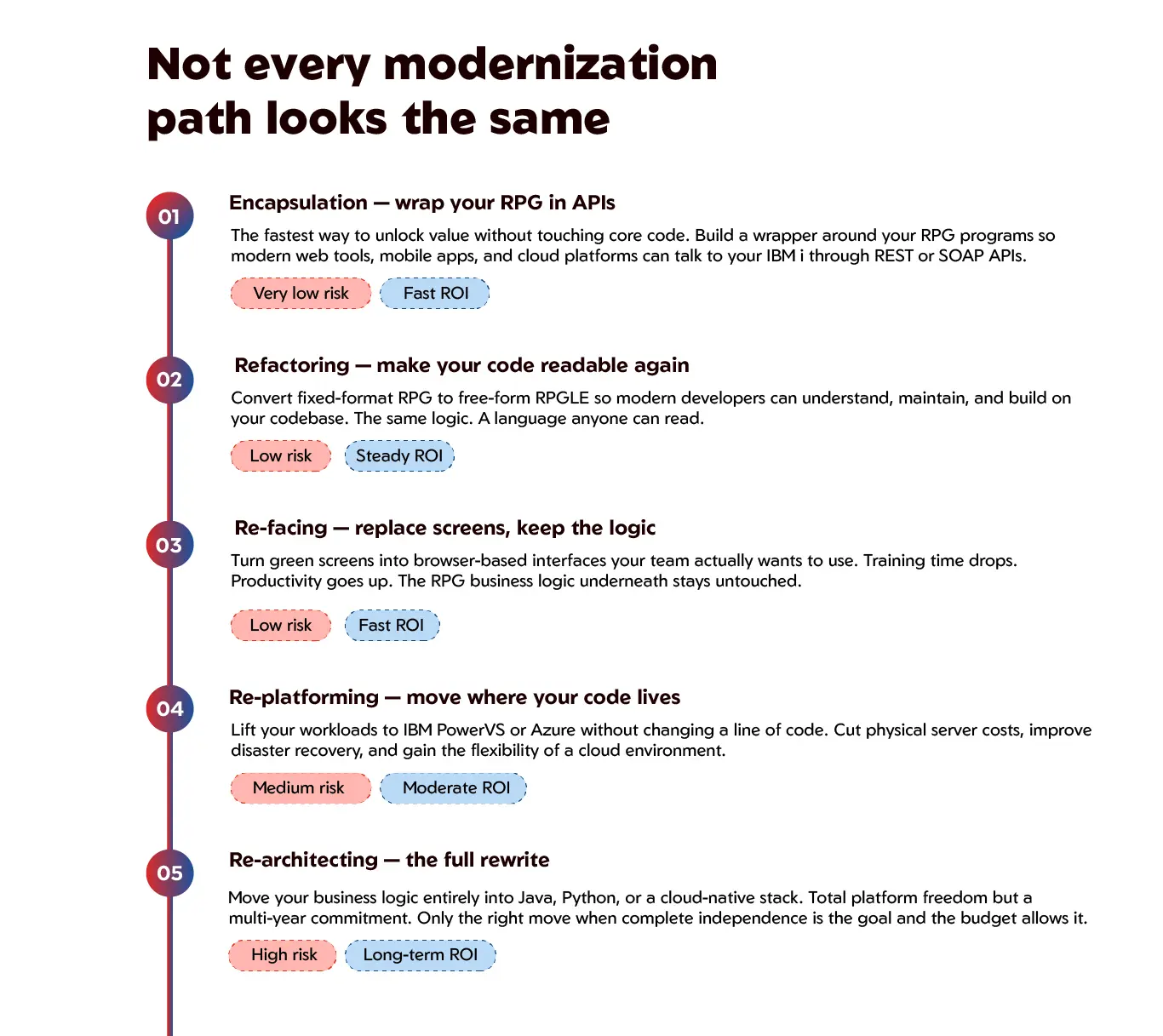
This table compares the real-world impact of each approach. It helps you see the balance between cost, speed, and long-term value.
| Modernization Path | Technical Risk | Business Impact | Typical ROI | Best Use Case |
|---|---|---|---|---|
| Encapsulation (APIs) | Very Low | Immediate | High / Fast | Connecting to Salesforce, AWS, or Mobile. |
| Refactoring (Free-Form) | Low | Long-Term | Steady | Fixing the talent gap and hiring new devs. |
| Re-facing (UI/UX) | Low | High (User) | Fast | Boosting productivity for data-entry staff. |
| Re-platforming | Medium | Operational | Moderate | Cutting data center costs and improving Disaster Recovery. |
| Re-architecting | High | Transformative | Long-Term | Moving to a 100% Java or Cloud-native stack. |
1. Encapsulation (The API-First Approach)
This is the fastest way to get value out of your IBM i without changing the core code. You build a "wrapper" around your RPG programs. This allows modern web tools to talk to your system using REST or SOAP APIs.
- The Benefit: You keep your stable business logic but gain the ability to connect to modern AI and Cloud tools.
- The Risk: It does not fix the underlying "messy" code; it just hides it.
2. Refactoring to Free-Form RPGLE
Refactoring is the process of cleaning up your code without changing what it does. You turn old, columnar RPG into a modern, text-based format.
- The Benefit: Modern developers can read and fix the code. This solves your hiring problems.
- The Risk: It takes time to test every program to ensure the logic stayed exactly the same.
3. Re-facing (Modernizing the User Experience)
This path replaces "Green Screens" with web browsers. Instead of typing function keys, your users click buttons and use dropdown menus.
- The Benefit: It slashes training time for new employees. Users work faster because the software feels like a modern website.
- The Risk: If you only change the "look" but keep the old workflows, you miss out on true process improvement.
4. Re-platforming (Moving to the Cloud)
Re-platforming means moving your workloads to a virtual environment like IBM PowerVS or Azure. You are not changing the code; you are changing where the code lives.
- The Benefit: You get rid of physical server maintenance and gain better disaster recovery (DR) options.
- The Risk: Connectivity speeds between your cloud and your local office must be perfect to avoid lag.
5. Re-architecting (The Full Rewrite)
This is the most complex choice. You move your logic into a new language like Java or C#. This often involves moving away from the IBM i entirely.
- The Benefit: You get total freedom from legacy hardware and can use standard DevOps tools.
- The Risk: This is a multi-year project. Most "Big Bang" rewrites fail because the original business rules were never documented.
Pathways to Modernize RPG Green Screens
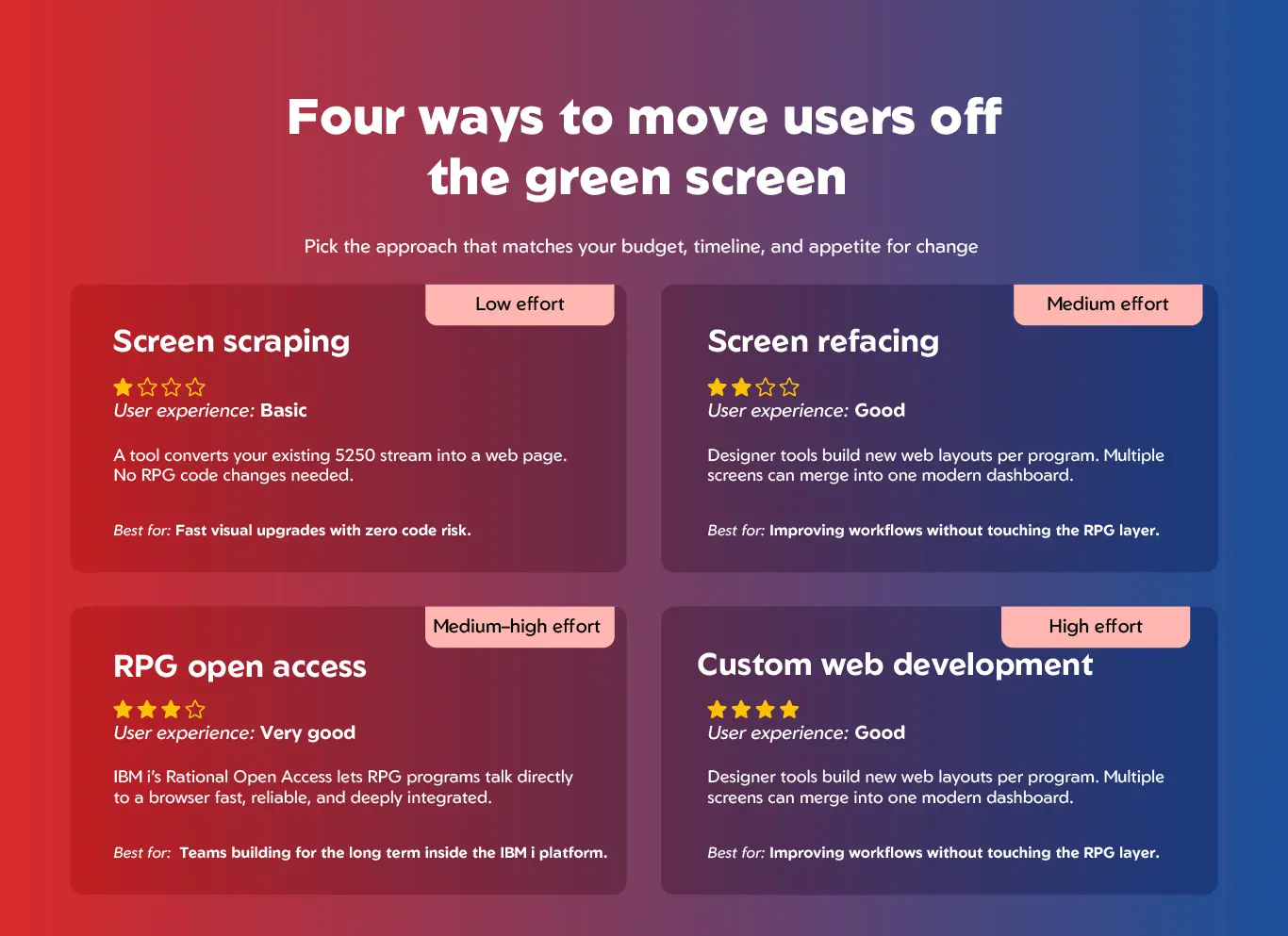
The 5250 "Green Screen" was built for speed before the mouse existed. Today, it is a barrier. You can replace these screens using four different technical paths.
1. Screen Scraping
This is the fastest way to get a web look. A software tool sits on top of your existing 5250 stream. It reads the text and turns it into a web page instantly.
You do not have to change any RPG code. It is the cheapest way to get a new interface. However, the workflow stays the same. If a task took ten screens to finish yesterday, it still takes ten screens today. It just looks like a website.
2. Screen Refacing
Refacing goes deeper than scraping. You use a designer tool to create new web layouts for specific programs. You can even combine data from three different green screens into one modern dashboard.
This path lets you improve how people work. You can add buttons, calendars, and images. Keep in mind that you still rely on the original RPG program to move the data. If that program changes, your web screen might break.
3. RPG Open Access
IBM i has a feature called Rational Open Access. This allows RPG programs to talk directly to web browsers instead of a terminal.
This is a professional way to modernize. The program knows it is talking to a web page, which makes the connection fast and reliable. You will need developers who understand how to write "handlers" for this feature. It requires more skill than basic scraping.
4. Custom Web Development
Here, you build a completely new front end using JavaScript or React. This new app talks to your RPG logic through APIs.
You get total control. Your software can look like a modern cloud platform. You can build mobile apps that work perfectly with your IBM i data. This is the most expensive path. It takes time because you are building every screen from scratch.
Comparison of UI Pathways
| Feature | Screen Scraping | Screen Refacing | Open Access | Custom Web |
|---|---|---|---|---|
| Effort | Low | Medium | Medium-High | High |
| User Experience | Basic | Good | Very Good | Excellent |
| Code Changes | None | Minimal | Some | Significant |
| Best For | Quick fixes | Productivity | Long-term UI | Innovation |
Tactical Code Modernization: Beyond the Basics
Most talks about application modernization stay on the surface. To move the needle, you have to deal with the spaghetti logic in your production library. You do not just modernize. You refactor with intent.
Stop Using Column-Based RPG
If your team is still counting spaces to place a statement, you are losing money. Fixed-format RPG is a specialized skill. Modern developers find it unreadable.
- Convert to Total Free-Form RPG. This is about making your business logic look like clean text.
The SQL Shift: Moving Logic to the Data
Legacy RPG is famous for record-at-a-time processing. You loop through a file, check a condition, and move to the next. This is slow and heavy on the CPU.
- Use Embedded SQL. You write one SQL statement instead of fifty lines of RPG to find a customer total.
- The SQL Query Engine on the IBM i is very fast. Moving logic from the RPG program into an SQL query reduces overhead. It makes your data easy for modern tools to read.
The Power of ILE
The biggest risk in legacy systems is the Monolith. This is one massive program that handles everything. If you change one line, the whole thing might break.
- Service Programs: Break your logic into small parts you can use again.
- The Strategy: Create a service program for tax math or credit checks. When rules change, you update that one part. You do not risk breaking your order system.
- The Payoff: This creates a single source of truth. You stop having the same code scattered across fifty different programs.
APIs: Turning RPG into a Service
You do not always need to move data off the IBM i to use it in a web app. You just need to wrap it.
- The Approach: Use RESTful APIs to show your RPG logic to the world.
- The Process: A web browser sends a JSON request instead of a green screen calling a program. Your IBM i sends the answer back.
- The Result: Your thirty-year-old code suddenly powers a mobile app. This is the fastest way to show value to the board.
The DevOps Gap
Modernization fails without a safety net. If you still move code by hand, you are working without a net.
- The Goal: Build CI/CD pipelines.
- How it works: Use Git for version control. When a developer changes code, a tool builds it and runs tests in a separate spot.
- The Benefit: You stop hoping the code works. You start knowing it works before it ever touches your live data.
Languages and Frameworks for RPG Modernization
Modernizing your system means moving toward an open environment. You are changing your entire language landscape to invite new talent.
Group 1: The IBM i Native Core
These are the languages that live closest to your data. Updating these is the first step in any in-place project.
- Free-Format RPGLE: This is the modern version of RPG. It looks like modern code and removes the old column limits. It allows your current team to write cleaner logic that new hires can actually read.
- CL (Control Language): You use this for job scheduling and automation. RPGLE modernization means moving to structured CLLE. This allows your automation to work with modern DevOps tools.
- Embedded SQL: This replaces old file methods. It allows you to use stored procedures and data views. It is the bridge between your legacy database and modern web apps.
Group 2: Open Source and Modern Backend
These languages run natively on the IBM i using the PASE environment. They allow you to tap into a global pool of millions of developers.
- Java: The full Java Virtual Machine is available on your system. It is perfect for building service layers and API gateways. If you want platform independence, Java is the standard.
- Python: IBM has made Python a first-class citizen on the IBM i. It is the best choice for data science, automation scripts, and modernizing your background tasks.
- Node.js: This is great for building fast web servers. Node.js can call your RPG programs directly. It turns your IBM i into a real-time engine for web and mobile apps.
- PHP: Many IBM i shops use PHP for web development. It is a reliable way to connect your business logic to a dynamic website.
Group 3: The User Interface (Front-End)
This is what your users actually see. These technologies replace the green screen with a modern experience.
- React, Angular, or Vue.js: These are the big three of web development. They allow you to build responsive, mobile-friendly screens. Your IBM i provides the data, and these frameworks provide the beauty and speed.
- Low-Code UI Platforms: Tools like Profound UI or Genie are for teams that want to move fast. They offer drag-and-drop features. You can build a web interface without needing a team of senior JavaScript experts.
The Modernization Tool Registry
This table is a guide for technical teams. It shows which tools solve specific problems, from cleaning up your code to moving your entire system to the cloud.
| Tool / Platform | Category | Why It Matters |
|---|---|---|
| VS Code + IBM i Extensions | Development | The new standard. It is open-source and feels like modern web development. |
| IBM RDi | Development | The professional choice. It offers deep refactoring and a powerful debugger. |
| X-Analysis (Fresche) | Analysis | It scans your entire codebase. It tells you what will break before you change a line. |
| Profound UI | UI / UX | A drag-and-drop designer. It turns RPG data into React-based web screens. |
| Genie | UI / UX | The fast path. It puts a browser face on your green screens with almost no code changes. |
| HTTPAPI (Scott Klement) | API Layer | The gold standard for RPG. It lets your programs talk to the web for free. |
| RPGLE.io (Liam Allan) | API Layer | A modern framework. It makes building REST services in RPG feel like Node.js. |
| RPGUnit | Testing | It allows for automated testing. You cannot do DevOps without it. |
| ARCAD Software | DevOps | An all-in-one platform. It handles the whole move from legacy to modern code. |
| IBM PowerVS | Cloud | IBM's official cloud. You move your workloads without changing your code. |
| Skytap on Azure | Cloud | Runs IBM i on Microsoft Azure. Perfect for hybrid cloud strategies. |
Choosing the Right Starting Point
You do not need every tool on this list at once. Your choice depends on where your biggest "pain" is today.
- If you cannot hire developers: Start with VS Code and Free-Format tools. This makes your environment look like the rest of the world.
- If your users are frustrated: Look at Profound UI or Genie. These give you immediate visual wins that the business can see and feel.
- If you need to connect to Salesforce or AI: Focus on HTTPAPI or RPGLE.io. These are the "pipes" that let your data flow to modern apps.
- If your hardware is aging:Explore PowerVS or Skytap. Moving to the cloud removes the burden of managing physical servers
The Real Risks of Modernization
Most projects fail because of the hidden traps in the organization. You have to handle these three areas with care to keep your project on track.
The Invisible Logic Trap
Your business rules are buried in thousands of lines of RPG. Many of these programs were written decades ago.
- There is no manual. The documentation is just the code itself. If your senior developers retire, you lose the "why" behind your core processes.
- Do not guess. Use automated analysis tools to map out your program calls and data flows. You must extract the rules before you can move them to a new language.
The Cost of a Clean Break
It is tempting to say you will just rewrite everything in Java or Python. This is often a billion-dollar mistake.
- The Reality: A "Big Bang" rewrite takes years and rarely delivers what the business needs on day one. You risk spending your entire budget while your old system continues to decay.
- The Fix: Move in cycles. Pick one high-value area, like your customer portal or your shipping logic. Modernize that piece and connect it back to your legacy core. This proves the value to the board without risking the whole company.
The User Resistance Factor
Your staff might have used green screens for thirty years. They are fast. They know every function key by heart.
- The Reality:If you give them a slow web interface that requires five mouse clicks instead of one keystroke, they will hate it. They will find ways to go back to the old system.
- The Fix: Build for speed. Use modern web frameworks like React to create an interface that is as fast as the green screen but twice as smart. Include your power users in the testing phase so they feel ownership of the new tool.
Managing the Data Split
During a long project, you will have two systems running at once. Some data stays in DB2 for i while other parts move to a modern cloud database.
- Keeping these two worlds in sync is a nightmare. If a customer changes their address in the new web app, that change must hit the legacy billing system instantly.
- Use an API-first strategy. Do not let the new app talk to the old files directly. Build a service layer that handles the handshake between both systems. This prevents data corruption and keeps your records accurate.
Where Industries Actually Go Wrong
Most people think modernization is the same for every client. That is a mistake. A bank and a factory have different pressure points. If you treat them the same, you miss the mark.
Manufacturing and Distribution
You have the most to gain from IoT. Your machines are on the floor, but your logic is in the server room. You need to close that gap. Do not try to move your scheduling logic to the cloud. It is too heavy. Keep it on the IBM i, but build a light API layer around it. This lets your new warehouse tablets and shop floor sensors talk to your core system in real-time.
Banking and Insurance
You are stuck between two worlds. You need the rock-solid reliability of your core RPG banking system, but your customers demand a sleek mobile app. Don't touch the core ledger. It works. Instead, build a service layer. Use modern languages like Java or Node.js to act as a bridge. This gives your mobile banking front end the speed it needs without forcing you to rewrite your entire back end.
Retail and Healthcare
You have a data problem. In retail, your inventory is scattered across dozens of channels. In healthcare, your patient records are locked in old billing files. Your path is data virtualization. Use SQL views to expose your data. This lets your telehealth portals and e-commerce websites pull the information they need instantly. You do not need to move the data. You just need to make it visible to the outside world.
The Five Nines Reality
You hear about cloud platforms promising uptime, but the IBM i actually delivers it. We are talking about the famous 99.999 percent uptime. When an hour of downtime costs you millions, you do not gamble with your infrastructure. The platform stays relevant because it simply does not go down.
The Throughput Engine
If you are running high-volume order processing or complex financial settlements, you need raw power. RPG programs on IBM Power hardware chew through massive transaction volumes in ways that standard web servers struggle to match. It is about how the hardware and the software were built to work together from day one.
Security by Design
Modern apps spend half their budget building security into the code. The IBM i uses an object-based security model that is baked into the platform itself. It is a fortress. You do not need to layer on dozens of security tools because the system assumes everything is locked by default. That kind of security is rare today.
The Cost-of-Ownership Trap
Everyone assumes the cloud is cheaper. It is not always true. When you factor in the cost of a full migration, the risk of breaking your business logic, and the reality of ongoing cloud monthly fees, keeping your stable workloads on the IBM i is often the smarter financial move. You are already paying for the power. Why pay for it twice?
The Myth of Modernity
The biggest lie in IT is that the IBM i cannot do modern things. It can. Your constraints are about investment, not the platform. Today you can use Free-Format RPG to call Python scripts. You can run Node.js inside the system. You can even use Git and Docker containers. The platform is ready for 2026. Your team just needs to start using these tools.
How to Choose the Right RPG Modernization Partner?
Choosing the right partner for an IBM i project is the most important decision you will make.
Do not settle for a vendor that only knows web development. You need a team that speaks RPG as a native language and understands modern cloud architecture.
Here is how to evaluate the team you are bringing on board.
Can They Actually Read Your Code?
Do not hire a team that only knows Java or Python. They will look at your legacy RPG II or III programs and try to rewrite them without knowing the business rules inside. You need a partner who can read your existing code, understand the logic, and refactor it safely. If they cannot explain what a specific subroutine in a 1980s program is doing, they should not be touching it.
Do They Have a Real Process?
There is no room for ad hoc work here. Look for a partner with a structured, repeatable process. They should have a clear path that starts with code analysis and ends with testing. If a vendor tries to sell you a "big bang" rewrite without first documenting your logic and assessing the risk, walk away.
Do They Own the Entire Stack?
Modernization is about connecting your back end to APIs, building modern front ends, and setting up DevOps pipelines. You need a partner that is comfortable in the IBM i environment but also understands how to deploy a React app or manage a CI/CD pipeline on the cloud. If they cannot do the whole stack, you will end up juggling too many vendors.
Have They Done This in Your Industry?
A manufacturing shop has different logic than a bank. The regulatory needs and the transaction flows are not the same. Demand references from clients in your specific vertical. You want to see that they have solved the exact type of complexity you face every day.
Do You Own the Output?
The goal is to escape your current dependency, not to trade it for a new one. Before you sign, be clear on code ownership and knowledge transfer. You need to own the documentation, the source control, and the logic. A good partner will train your team throughout the project so you are not dependent on them once the contract ends.
Can They Flex to Your Needs?
You might need an extension of your team, or you might need a partner to take over the entire program. A good partner will be flexible. They should be able to jump in wherever you have a gap, whether that is full managed services or just specialized consulting for a few months.
Closing Thoughts
You have a system that is built like a tank. It has run your business for thirty years without failing, but a tank cannot win a race. Today, your customers and your team expect the speed of a startup. You are not just fighting old code. You are fighting a slow way of doing business.
Modernization is about taking the logic that already works and setting it free. You do not have to throw away your foundation to get the benefits of the cloud, mobile apps, or AI. You just have to build the right bridges.
The cost of waiting is now higher than the cost of action. Every month you delay, your talent pool shrinks and your competitors move further ahead. You can either wait for a crisis to force your hand, or you can turn your legacy core into your biggest advantage.
You have the business logic. We have the roadmap to make it move.
The next step is yours. Book a consultation with SrinSoft’s solutions expert team to develop your RPG or COBOL enterprise modernization strategy, explore how your business can overcome RPG / COBOL challenges, and ensure a future of innovation and growth.