[ Sep
14-17
] Save the date for inPOWER 2026
[ Sep
14-17
] Save the date for inPOWER 2026
 Email:
inquiry@srinsofttech.com
Email:
inquiry@srinsofttech.com Phone:
+1 (614) 333-5277
Phone:
+1 (614) 333-5277







A white pencil looks useless on white paper. Switch to a black surface, and it suddenly becomes impossible to ignore.
COBOL lives in the same paradox. Dismissed as outdated, yet still executing the high-volume transactions behind many of the world’s largest banks and insurance companies.
The greatest modernization risk is not technology failure. It is executive misdiagnosis.
COBOL Modernization:
Three viable paths exist: extend COBOL through APIs, rewrite high-friction modules, or modernize the IBM i platform. The wrong choice is full replacement without a constraint-driven reason.
Modernizing COBOL Applications on IBM i – The Real Problem is Your Optionality
Walk into any Fortune 500 boardroom and mention COBOL modernization. You’ll trigger panic about replacing “ancient technology” or dismissal because “it still works fine.” Both miss the point.
The constraint hierarchy:
Knowledge concentration: With 220 billion lines of COBOL code remaining in use globally, the issue isn’t whether COBOL survives—it’s whether your institutional knowledge does. Three to five people in a company understand critical business logic in code written before the internet existed.
Integration tax: Every new initiative hits the same wall—COBOL often requires additional architecture. You build custom middleware every time. Projects stretch from three months to nine because half the timeline is translation layers between 1985 and 2025.
Talent Pipeline: With a shrinking talent pool and aging workforce, specialized COBOL expertise increasingly commands premium rates.
“Modernization” sold as rip -and-replace means 3-5 year projects with 60%+ failure rates.
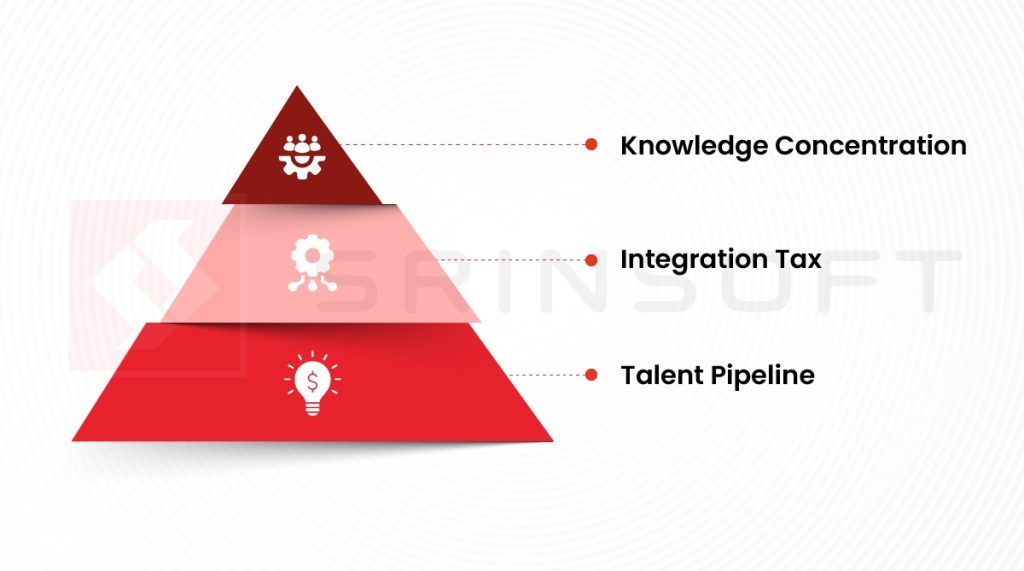
You’re choosing which constraint costs you the most: maintaining current state, gradual evolution, or big-bang replacement. Each has a price.
The Hidden Risks Executives Consistently Underestimate
Knowledge Loss:
Retiring engineers carry undocumented system intelligence—not just code comprehension, but why specific logic exists. A calculation that looks arbitrary often encodes a regulatory settlement from 1991 or a fraud pattern discovered in 2003. When those engineers leave mid-modernization, that context vanishes.
Academic research on legacy system transitions flags knowledge transfer as the primary predictor of post-migration stability. You migrate the code but lose the reasoning. Six months post-launch, when edge cases surface, nobody remembers why the old system handled them that way.
Validation Failure: The Functional Parity Problem
Transformed code must behave exactly like the original under all conditions. A banking system that processes 10 million transactions daily encounters thousands of edge cases monthly. Your new system needs to handle all of them identically.
Research into automated testing frameworks for financial systems stresses one requirement: behavioral equivalence before deployment. Functional parity – If your modernization can’t prove it transaction-by-transaction, you’re betting the business on incomplete testing.
Cyber Exposure During Transition
When you’re running old and new systems in parallel, with custom integration layers shuttling data between them, you’ve created the weakest link: temporary architecture which is never secure.
Attackers target organizations mid-modernization because security controls are split across two paradigms, monitoring tools don’t cover the translation layers, and everyone’s focused on functionality.
Governance Drift
Modernization projects expand. What starts as “wrap COBOL in APIs” becomes “re-architect the data model” becomes “consolidate four business units.” Scope creep is almost guaranteed without executive guardrails enforcing constraint-focused roadmaps.
Interface Modernization Gap
Modernizing COBOL while preserving green screen interfaces creates adoption failure. You invest millions in backend transformation but leave 1980s interaction models intact. Users resist. Adoption drops. Three years later, you fund a second program to modernize the UI.
Two transformation programs. Double the cost. Single outcome you could have achieved once.
The fix: Modernize user green screen interfaces in parallel with backend work.
Should you modernize your COBOL systems?
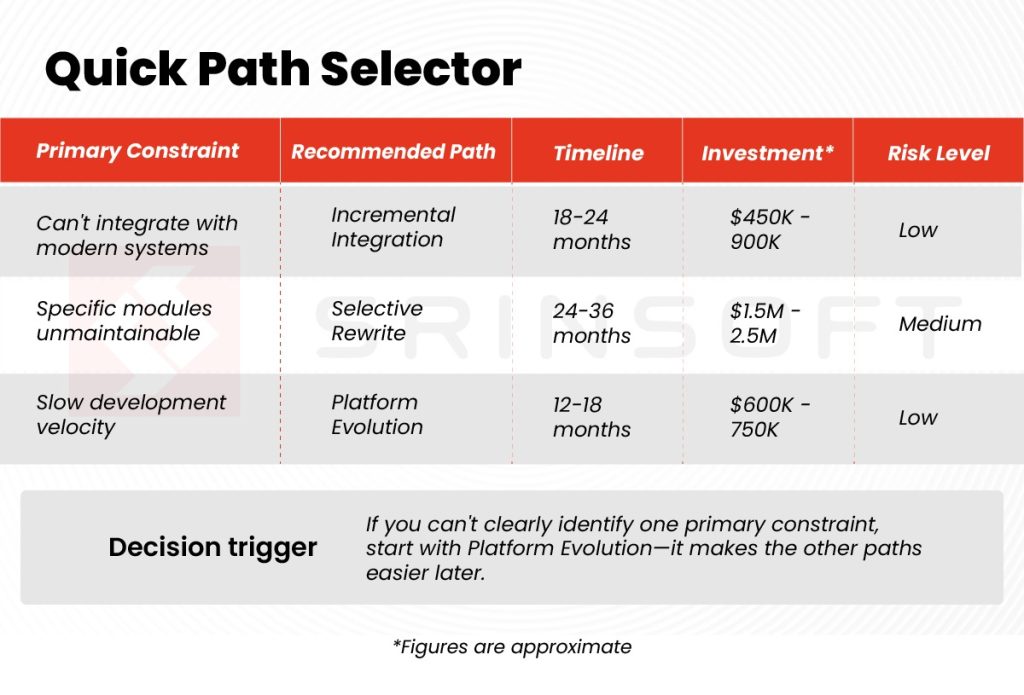
Yes—but not by replacing them. Identify your primary constraint: can’t integrate with modern systems? Wrap COBOL with APIs. Specific modules unmaintainable? Rewrite selectively. Development too slow? Upgrade tooling and processes.
Don’t modernize COBOL. Modernize around it. The code works. Fix what’s actually broken: integration limits, knowledge gaps, or development velocity.
Three Modernization Paths: What They Actually Cost
Modernizing COBOL systems usually involves either optimizing the existing codebase or transforming it into modern languages like Java, C#, or .NET. This process begins with deep code analysis, refactoring, and sometimes the use of AI-powered tools to automate parts of the transformation while preserving business logic. Planning, testing, and documentation are essential for success. Let us list three distinct paths:
Path 1: Incremental Integration (18-24 months, lowest risk)
What it is: Wrap COBOL services with REST APIs, connect to modern data layers, expose functionality without touching core logic.
Constraint: Integration Limits.
Real-world application: Insurance claims processing—COBOL handles the calculation engine, new Node.js layer manages customer-facing APIs. Banking core systems—transaction processing stays in COBOL, mobile apps call through API gateway.
True cost structure*:
- Middleware/API layer: $200K-500K
- DevOps pipeline updates: $150K-300K
- Training existing team: $100K
Hidden cost: Maintaining two stacks long-term
Path 2: Selective Rewrite (24-36 months, surgical risk)
What it is: Identify the 20% of code causing 80% of maintenance burden. Rewrite those modules in modern languages. Leave the proven core untouched.
Constraint: Specific modules becoming unmaintainable
Candidate identification:
- Modules changed more than 10 times per year
- Features blocking new business capabilities
- Components where COBOL talent is the bottleneck
Real-world example: Major retailer rewrote inventory forecasting (high change frequency) in Python. Kept order processing in COBOL—zero defects, handles Black Friday spikes flawlessly.
True cost structure:
- Business logic archaeology: $300K-600K (documenting what the code actually does)
- Rewrite plus parallel testing: $800K-1.5M per major module
- Integration scaffolding: $400K
Hidden cost: Risk of breaking undocumented business rules
Path 3: Platform Evolution (12-18 months, infrastructure risk)
What it is: Keep COBOL, upgrade everything around it—IBM i OS updates, modern tooling, automated testing, CI/CD pipelines.
Constraint: Development process holding you back.
What changes:
- Source control: Git instead of library management
- Automated testing frameworks for COBOL
- Modern IDEs with debugging capabilities
- Container deployment options
True cost structure:
- Tooling and infrastructure: $250K-400K
- Process transformation: $200K
- Team upskilling: $150K
Hidden benefit: Makes other paths easier later.
A Decision Framework for the C-Suite
Before choosing a modernization path, answer these five questions honestly. Your answers determine whether you’re making a $2 million investment or a $20 million mistake.
1. What is our operational risk tolerance?
Downtime tolerance determines strategy.
Scenario: Your bank processes $50 billion daily. A four-hour cutover means $8 billion delayed, broken compliance, missed payrolls. This demands incremental integration—18-month parallel run, gradual migration.
Back-office reconciliation? Six-hour windows work. Failed cutover? Retry tomorrow. Higher tolerance permits aggressive replacement.
Know your downtime cost per hour.
2. Where does business logic actually live?
Many organizations don’t know. That’s alarming.
Scenario: Insurance premium calculations span COBOL, stored procedures, quarterly-updated Excel files, and manual underwriter overrides. The Excel file—unvalidated since 2008—is known by three people.
Budget: $3M. Actual: $8M. Half spent documenting existing logic.
Map before migrating.
3. Are we modernizing for agility or cost?
Confusing them guarantees failure.
Scenario: CFO wants 30% cuts. CMO needs monthly launches. You pick low-code for “fewer developers.”
Result: 15% OpEx drop, 4-month launches. Competitors ship weekly.
Right choice: APIs and microservices. $6M vs $4M, but 2-week launches unlock $40M annually.
Cost saves money. Agility makes money.
4. Do we have validation infrastructure?
Without it, you’re gambling.
Scenario: ERP replacement validated manually at 94% match. You launch.
72 hours later: wrong inventory, incorrect shipments. Different rounding, different exceptions. $15M in stockouts. Rollback after $12M spent.
Prove 99.99% match before production.
5. Are we prepared for hybrid?
You will run hybrid. Plan for it.
Scenario: “Temporary” 18-month integration layer still runs five years later. Works perfectly. But minimal monitoring, no ownership, sparse docs.
Midnight failure. Six hours down. $4M lost. Nobody knows the queue.
Treat hybrid as permanent architecture.
Final Reality Check
Your COBOL system did not become critical by accident. It earned that position by reliably running the transactions your business depends on. That is not technical debt. It is proven operational value.
Legacy systems are rarely operational failures. More often, they are proof of infrastructure that performed so reliably the business built itself around it.
Modernization isn’t about fixing what’s broken. It’s about preventing three future scenarios: the key person quits, the integration becomes impossible, or the opportunity cost becomes unacceptable.
The companies that win aren’t the ones that replace COBOL fastest. They’re the ones that remove constraints strategically, preserve competitive advantages, and maintain optionality.
Start with the constraint costing you customers. Everything else is just architecture.
Most modernization failures begin with misdiagnosis. If you are evaluating your path on IBM i, start with a constraint analysis before committing capital.
Need help identifying which modernization path fits your constraints? SrinSoft specializes in IBM i and COBOL modernization strategies that preserve what works while removing what doesn’t. Let’s talk about your specific constraints.
FAQs
1. Is COBOL modernization actually worth the risk if the system is still stable?
Yes, if your constraint is slowing the business. Stability today does not guarantee resilience tomorrow. Modernize when integration, talent risk, or change velocity starts limiting growth. Do not modernize just because the technology is old.
2. What is the safest way to modernize COBOL without disrupting core transactions?
Start by extending, not replacing. Expose services through APIs, modernize high-friction modules, and run parallel validation before switching anything off. Protect transaction engines first. Speed is secondary to continuity.
3. Should we replace COBOL or wrap it with APIs on IBM i?
In most cases, wrap first. IBM i already supports modernization patterns that let you extend COBOL safely. Replacement is justified only when the system blocks strategy or becomes economically unsustainable.
4. How do we modernize COBOL if the people who understand it are retiring?
Capture knowledge before changing anything. Document critical logic, record walkthroughs, and use automated code analysis tools. Losing system knowledge mid-program is one of the fastest ways to derail modernization.
5. What are the biggest COBOL modernization failures, and how do we avoid them?
Common failures:
- Misdiagnosing the real constraint
- Underestimating hidden business logic
- Weak testing and validation
- Treating hybrid architecture as temporary
Avoid them by: mapping logic early, automating validation, modernizing in phases, and aligning the effort to a clear business objective.