






Your competitors aren’t moving faster due to smarter AI choices. They’re moving faster because their systems can support change.
Across industries, teams are automating work that once took days. The difference isn’t ambition. It’s readiness. Many core applications were built in an era where reliability mattered more than adaptability. They continue to run well, but today’s demands place very different pressure on them.
That strain appears quickly. Accessing data takes effort. Integrations stretch timelines. Even small updates require coordination across teams, slowing momentum. The technology holds steady, yet progress feels constrained.
This is where modernization becomes relevant. As a way to regain control over how change flows through the organization.
This guide explains how to approach that shift, step by step.
What Legacy Application Modernization Actually Means?
Legacy modernization is the process of transforming an existing system to align with modern business needs. It is about eliminating technical friction.
To do this effectively, we focus on five core pillars:
- Architecture – Moving from monolith to decoupled services. This ensures that one small failure doesn’t crash into your entire operation.
- Integration – Shifting from manual batch processing to stable, real-time API contracts. This is the only way to connect to modern SaaS and AI tools.
- Data – Replacing point-to-point extracts with governed data pipelines. This ensures your data is clean and accessible across the enterprise.
- Delivery – Implementing CI/CD to remove human error. If your deployments depend on ‘hero’ engineers, your system is at risk.
- Operations – Adding observability. You need real-time logs and audit trails to manage a system effectively in a high-security environment
Why Should you Modernize Legacy Applications?
Your old systems are draining resources that should be building your future. Every dollar spent maintaining outdated infrastructure is a dollar not spent on growth, innovation, or staying competitive.
- Capital Efficiency – Stop spending most of your budget just to keep old machines running.
- Speed to Market – Get rid of the slow, manual tasks that happen because your apps don’t talk to each other.
- Talent Retention – Good people quit when they have to use broken, 20-year-old tools every day.
- Real-Time Visibility – You can’t run a business on yesterday’s data; you need to see what is happening right now.
- Risk Mitigation – Old systems are easy targets for hackers. Modern tech has security built-in.
7-Step Legacy Applications Modernization Strategy
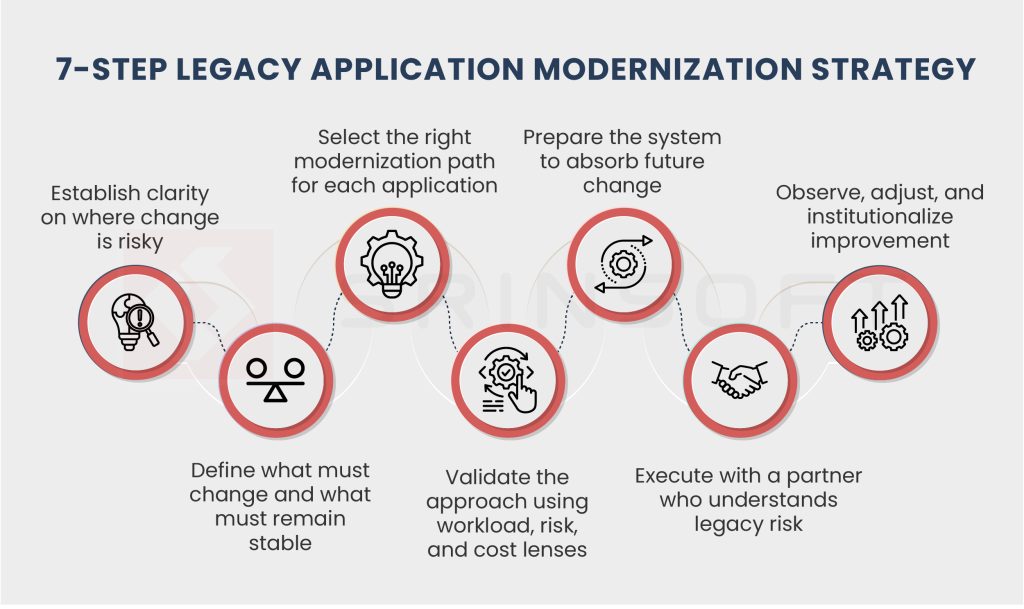
Most modernization projects fail because teams jump straight to solutions. Cloud migration. Microservices. Containers. All the trendy answers before anyone asks the actual question.
Start here instead: What’s breaking right now? Where’s the evidence? What’s costing us money, time, or customers today?
Get those answers first. Then figure out what to do about it.
Step 1. Evaluate the legacy system. Score it like a grown-up
You need a baseline that both business and engineering can agree on. A common way is to score the application using six drivers:
- Business fit – Does it still do what the business actually needs?
- Business value – Is it generating revenue or just consuming budget?
- Agility – How fast can you make changes when the market shifts?
- Cost – What’s it really costing to keep the lights on?
- Complexity – Can anyone besides two people actually work on it?
- Risk – What happens if it goes down or gets breached?
This isn’t a feel-good workshop exercise. Back it with real data.
Step 2. Define the real problem in plain language
After scoring your system, you’ll want to jump straight into solutions. Don’t. This is where teams waste months modernizing the wrong thing.
Start with user stories that describe actual pain:
- Support needs 6 weeks to add a single field to the customer screen
- Finance waits 3 weeks of testing before report numbers match
- Integration estimates always come back as “we need to investigate”
Connect each pain point to its technical cause:
- Changes take weeks because too many processes share the same data
- Testing drags on because core business rules aren’t isolated
- Integrations stall because interfaces aren’t stable or versioned
Step 3. Choose the modernization path. Use the 7 Rs, then pick based on system reality
Here’s where teams go wrong. They pick one approach early, “we’ll move everything to cloud” or “we’ll rebuild from scratch”, then spend months fighting reality when parts of the system don’t fit that plan.
Different applications need different approaches. Use the 7 Rs framework to match the right strategy to each system.
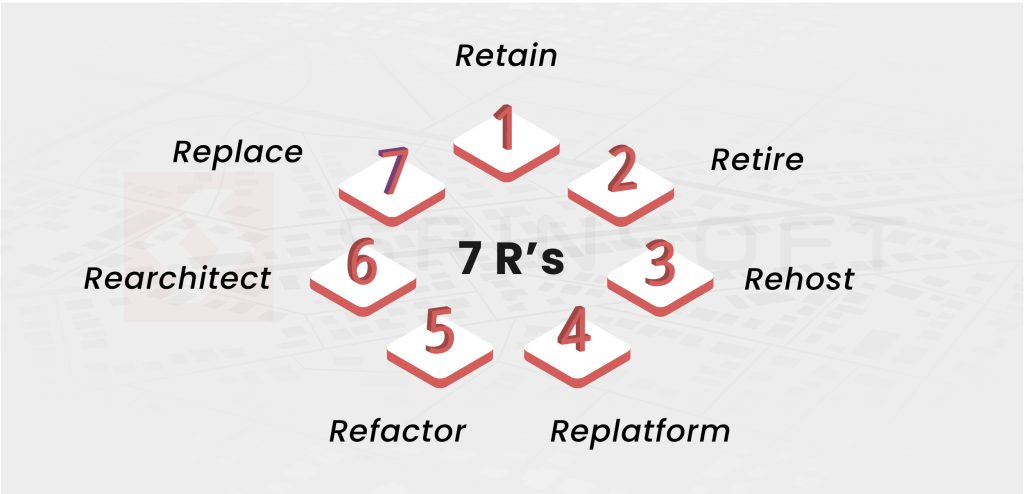
The 7 Rs. What they Mean in Technical Terms
- Retain: Keep it as it is. If the app works and doesn’t need to change, don’t spend money on it.
- Retire: If the app is rarely used, turn it off. This saves on licensing and security risks.
- Rehost (Lift & Shift): Move the app to the cloud without changing the code. It is the fastest way to save on hardware costs.
- Replatform: Move to the cloud and make small updates (like changing the database) to improve performance.
- Refactor: Improve the code so the app can use modern cloud features like auto-scaling.
- Rearchitect: Break a large, messy system into smaller, independent pieces. Use this for your most important apps that need frequent updates.
- Replace: Stop using custom code and switch to a ready-made software (SaaS) like Salesforce.
Step 4. Choose the Application Modernization Approach
Don’t pick an R based only on what looks easiest. Evaluate each option against six technical factors to find what actually works for your system.
Six factors that determine the right approach
| Factor | What to evaluate? | Why it matters |
| Workload | Traffic patterns (steady vs spikes), batch windows, response time needs, stateful vs stateless | Steady workloads can rehost. Unpredictable spikes need refactoring for auto-scaling |
| Architecture | Code coupling, clear boundaries between functions, dependency chains | Loosely coupled systems can refactor. Tightly coupled monoliths need rearchitecting |
| Cost | Development + infrastructure + licenses + support + testing + deployment | A cheap rehost with expensive legacy licenses isn’t actually cheap |
| Risk | Blast radius if it fails, rollback speed, cutover complexity, data correctness | High-risk systems need safer, slower approaches |
| Operations | Monitoring visibility, deployment frequency, incident playbooks, environment consistency | Can’t modernize to microservices if you can’t monitor a monolith |
| Security | Authentication model, access controls, audit capability, patch speed, secrets management | Security gaps force faster modernization or careful rearchitecting |
Step 5. Prepare for future growth and change
The real risk is not today’s workload. The real risk is what happens when regulations change; business models shift, or demand spikes without warning. Systems that can’t adapt quickly turn those moments into crises.
If every update feels risky and takes months, your modernization missed the point. Connecting legacy systems to newer tools buys time but doesn’t make them flexible.
For the parts under constant pressure like customer features, integrations, and reporting, refactor or rearchitect them. Make these areas modular so changes happen in one place without breaking everything else.
The goal is to reach a state where the system evolves continuously without forcing another major overhaul down the line.
That means clear boundaries, so changes stay contained, stable interfaces, so new features plug in cleanly, independent deployment, so updates don’t require coordinating everyone, and good monitoring so you catch problems before customers do.
Modernization should make future changes easier, not just fix today’s problems.
Step 6. Choose a partner who protects the business while you change it
Your internal team runs the current system well. But modernization is different. It requires expertise in modern architecture, cloud platforms, migration strategies, and risk management that most internal teams simply don’t have. Building that capability in-house takes years. You don’t have years.
Making the wrong decisions during modernization can break critical operations. Choosing the wrong approach costs millions. Moving too fast creates outages. Moving too slow means competitors keep pulling ahead.
This is where working with a specialized partner makes the difference. SrinSoft has guided dozens of enterprises through legacy modernization, particularly for IBM i and long-standing enterprise systems. We know where risks hide in these platforms, which approaches work for your specific environment, and how to modernize without disrupting the operations that generate your revenue.
Step 7. Observe and improve continuously
Go-live is not the finish line. It’s a checkpoint. What matters is how the system performs once real usage, real deadlines, and real pressure return.
Watch the signals that reflect business confidence, not just technical metrics.
- How predictable are releases?
- How quickly can teams assess the impact of a change?
- How often do defects appear after deployment?
- Are financial and regulatory outputs still consistent?
When these signals improve over time, modernization is working. When they stay flat or get worse, something needs adjustment.
Treat this as an ongoing discipline. Course-correct early, reduce future risk, and turn modernization into a sustained capability rather than a one-time project that eventually needs repeating.
Closing Thoughts
Modernization rarely feels urgent until the day it gets forced on you. By then, your choices shrink, risk climbs, and timelines are no longer yours to control.
The real cost is the time lost every quarter deciding, delaying, and working around constraints that should not exist.
The opportunity is now, not when the system finally breaks.
Your competitors are already modernizing. The question is whether you’ll catch up or fall further behind.
SrinSoft specializes in modernizing IBM i and legacy enterprise systems without disrupting operations. We help you assess risk, choose the right approach, and execute with confidence.
Schedule a modernization assessment with our team. Get a clear picture of where your constraints are and what to do about them.