








Imagine running a restaurant where every dish must be cooked in a separate kitchen – one for pasta, one for soup, and one for dessert. You’d waste hours moving ingredients around, training separate chefs, and trying to keep every kitchen consistent.
That’s exactly what happens when organizations manage multiple, isolated EDI data transformations for each partner or system.
What looks like operational friction on the surface often shows up elsewhere, in rejected documents, partner penalties, and chargebacks no one traces back to EDI design decisions.
EDI data transformation pipelines fix that chaos. It acts like a single, well-organized kitchen where every recipe (such as CSV, XML, JSON) follows the same workflow, ensuring data moves cleanly from one format to another, no matter the trading partner.
Did you know? Organizations lose up to $1.3 million annually due to inefficient processes weighing employees down, according to a 2022 report by Formstack and Mantis Research.
TL;DR
Right now, your EDI probably works, but only because your team is quietly performing daily heroics. EDI pipelines are how you retire the heroics. They turn scattered, partner-by-partner chaos into one smooth, automatic assembly line. Suddenly, onboarding just takes days. Errors stop ambushing you at 4 PM. Legacy systems stop holding you hostage. And your supply chain finally runs like it belongs in this decade. In short: build one great pipeline, and everything downstream just… works.

What is Electronic Data Interchange (EDI)?
Think of EDI as businesses texting each other, but instead of emojis, it’s purchase orders flying back and forth instantly. EDI speeds up transactions, cuts errors, and keeps supply chains flowing smoothly- all without adding extra people to the process and you know that.
Why EDI Data Transformation Pipelines Actually Matter
- EDI Transformation: This is the single act of converting one EDI format into another—like turning an EDIFACT file into XML or mapping an 850 purchase order into your ERP’s format. It’s the conversion step.
- EDI Transformation Pipelines: This is the entire workflow wrapped around that transformation.
In modern operations, you’re orchestrating dozens (maybe hundreds) of trading partners across continents. Without solid transformation pipelines, you’re basically running a global supply chain through Google Translate. Orders get misread, shipments go rogue, and your team drowns in manual fixes.
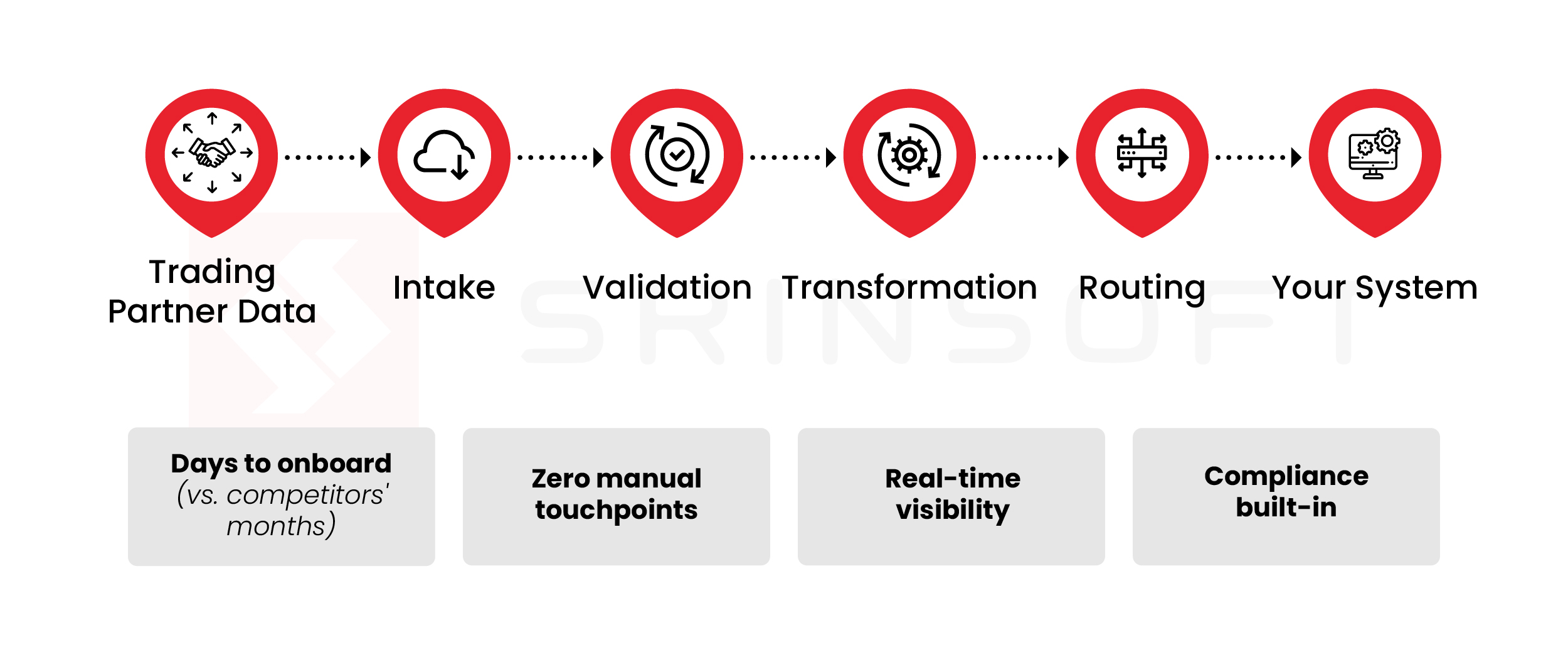
A typical pipeline moves from intake → validation → transformation → enrichment → routing → delivery — with error-handling baked into every stage.
Why EDI Pipelines Matter for Enterprise Growth
Here’s why smart enterprises are betting big on EDI pipelines for Business Process Automation:
- Speed to Market: Onboard new trading partners faster. Your competitors are still scheduling kickoff meetings while you’re already processing orders.
- The Hidden Tax of Manual Processing: Every human touchpoint costs you money and introduces errors. Beyond labor costs, manual corrections quietly trigger chargebacks—incorrect invoices, failed acknowledgements, or missed SLAs that retailers enforce without negotiation.
- Real-Time Visibility: Stop managing your supply chain through the rearview mirror.
- M&A EDI Integration Strategy: Acquiring companies? Their janky EDI setup becomes your problem. Robust pipelines absorb different systems without the integration nightmare.
- Compliance Management: Regulatory requirements change. Trading partner specs evolve. Good pipelines adapt with configuration changes. For large retailers and trading partners, one malformed document or delayed response often translates directly into chargebacks.
Did you know: Walmart, Amazon, and Target now require all suppliers to meet strict EDI standards before any trading can begin
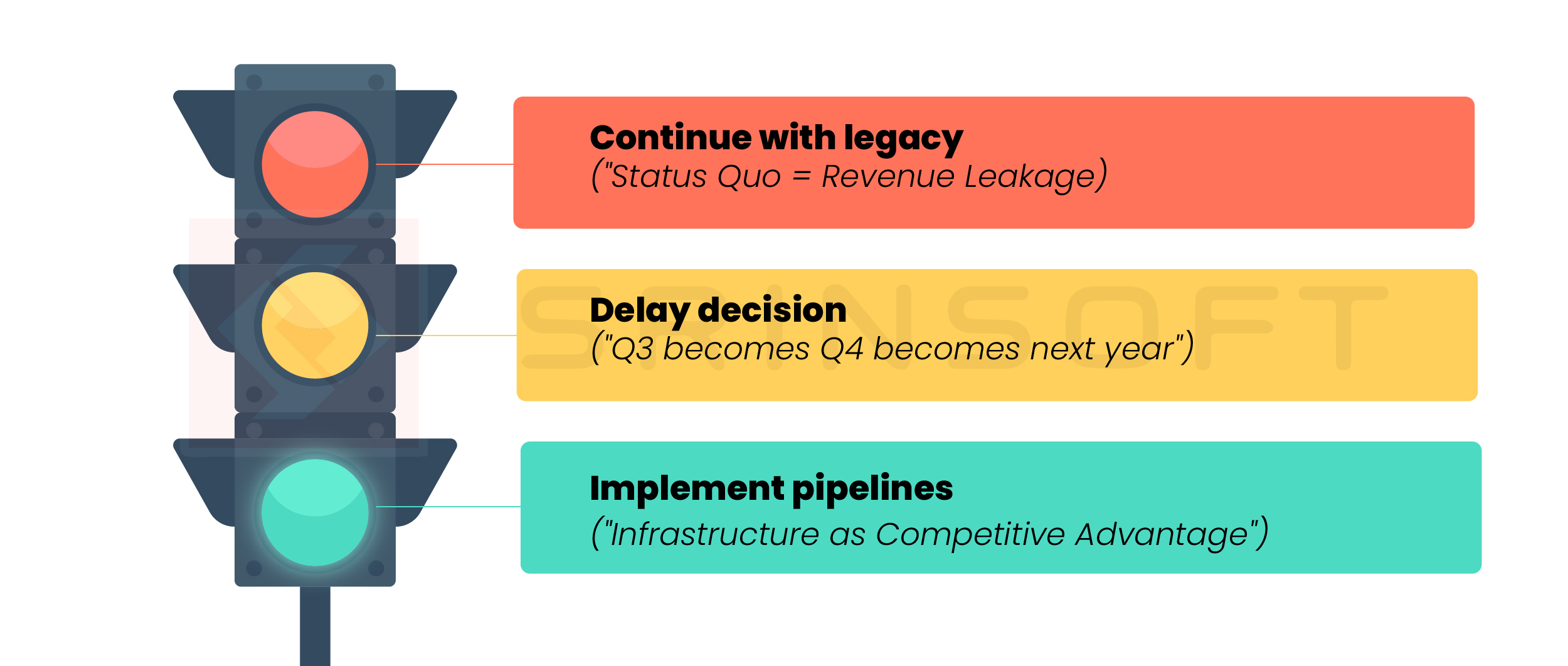
Why Do Leaders Delay Implementing EDI Data Transformation Pipelines
Let’s talk about the elephant in the boardroom. Here are the real reasons EDI transformation keeps sliding to next quarter:
- “If It Ain’t Broke… Right?”
Your current setup is limping along. Orders are processing. Partners aren’t openly revolting. The pain is chronic, not acute—so it never hits crisis level.
Reality: You’re bleeding margin through manual workarounds and your team is one key person’s resignation away from total chaos.
- The Sticker Shock Myopia
Upfront investment looks scary on a spreadsheet.
Reality: What doesn’t show up? The hidden costs you’re paying right now; the data entry team, the error corrections, the delayed shipments, the partners you can’t onboard because your infrastructure can’t handle them. What rarely makes it into the ROI model: recurring chargebacks from document failures, compliance misses, and partner rejections that teams have normalized as “cost of doing business.”
- “We’ve Got Bigger Fires”
There’s always a sexier initiative competing for budget. New CRM, AI pilot, market expansion, that acquisition everyone’s excited about.
Reality: EDI pipelines are infrastructure that brings in ROI faster than you imagine.
- “IT Says It’s Complex”
When technical teams emphasize difficulty without translating business impact, it’s easy to deprioritize.
Reality: The conversation needs flipping: What revenue are we leaving on the table? What partnerships are we turning down? What’s our competition doing while we deliberate?
Core Steps in Managing EDI data transformation pipelines for Business Impact
Getting EDI pipelines right isn’t rocket science; but it does require thinking like an architect, not a plumber.
- Evaluating Current Infrastructure and Business Processes
Start with brutal honesty. Map every system, every format, every workaround your team has jerry-rigged over the years. Your audit will expose the usual suspects; outdated mappings, inconsistent formats, unclear expectations; things everyone knows exist but nobody wants to admit.
Cloud-based? On-premise? Hybrid? High-volume retailers need different architecture than manufacturers with complex customization. Choose based on transaction volumes, partner diversity, and how fast you’re planning to grow.
- Build for Scale, Not Just Today’s Needs
The technical foundation matters:
- Data mapping: Establish clear translation rules between your systems and each partner’s format – one “customer ID” becomes their “account reference”
- Scalable architecture: Design to handle 10x transaction volume without rewrites.
- Quality controls: Test edge cases and format violations before they cascade into inventory nightmares
- Live monitoring: Real-time dashboards tracking throughput, error rates, and transformation times with quarterly optimization reviews
Best Practices for EDI Pipeline Management
- Ensuring Consistent and Accurate Data Mapping
Create a single source of truth. When marketing calls something a “product SKU” and logistics calls it an “item number,” your pipeline shouldn’t have to guess. Create naming conventions your team can actually follow, enforce them ruthlessly, and audit them quarterly.
- Automating Error Detection and Reducing Costs
Build intelligent validation rules that catch problems before they propagate (wrong date formats, missing required fields, values outside expected ranges). Not every mistake deserves a fire drill: log the small stuff, alert the medium stuff, and stop the line only when something truly mission-critical breaks. Catching format violations and missing fields upstream prevents downstream chargebacks that surface weeks later, long after the original error is forgotten
- Streamlining Trading Partner Onboarding
Build onboarding playbooks with templated configurations for common scenarios. Self-service portals where partners can test their connections before going live. Your sales team promises two-week onboarding? Your pipeline better deliver it.
- Strengthening Documentation and Governance
Here’s what happens without it: the person who built your transformation logic leaves, and suddenly nobody knows why certain rules exist or which partner requires that weird exception. Document everything; transformation logic, business rules, partner-specific quirks, incident resolution procedures. Establish change control processes so updates don’t accidentally break working integrations.
Key Business Challenges in Managing EDI data transformation Pipelines
- Data Mapping Complexity as Network Grows
You start with five trading partners and clean, logical EDI mappings. Fast forward two years: you’re at fifty partners, each with their own “interpretation” of standard formats. Partner A calls it “ship-to,” Partner B says “delivery location,” Partner C insists on “consignee address”- all meaning the same damn thing.
The multiplication problem kicks in hard. It’s not linear growth, it’s exponential. Each new partner potentially needs custom mappings to multiple internal systems. Your elegant initial design becomes a sprawling web of exceptions, edge cases, and “temporary” workarounds that somehow became permanent.
Nobody owns the full picture anymore.
- Maintaining Compatibility with Legacy Systems and Evolving Standards
EDI standards evolve – new versions, updated requirements, deprecated fields. Your carefully constructed pipelines now need constant care and feeding. That X12 4010 integration you built? Partner wants 5010.
Then there’s the innovation paradox for EDI modernization. You want to modernize, adopt APIs, embrace real-time data flows. But you can’t just rip and replace, those legacy systems run critical operations. So you end up maintaining dual infrastructure: the old world and the new world, with your pipeline as the expensive bridge between them.
You’re negotiating between the “move fast” crowd and the “don’t break production” crowd.
These challenges aren’t reasons to delay; they’re reasons to build it right the first time.
Conclusion: What Happens Next
The Strategic Reality Check
Your pipeline maturity directly correlates to three things the board actually cares about:
- Revenue velocity: How fast can you activate new channels and partnerships?
- Operating leverage: Can you double transaction volume without doubling headcount?
- Enterprise resilience: When regulations change or markets shift, do you adapt or scramble?
When boards ask about margin erosion, chargebacks tied to EDI failures rarely show up as a line item, but they absolutely show up in the numbers.
Time to Move
Here’s your play: Stop managing a dozen separate kitchens and build one world-class operation.
Stop calculating what modernization costs. Start calculating what delay costs.
Why Organizations Choose SrinSoft
Since 2005, we’ve specialized in legacy transformation and EDI modernization for enterprises that can’t afford downtime or do-overs.
Our approach:
- Parallel implementation.
- Phased migration.
- Infrastructure that adapts as your business evolves.
Schedule a consultation to benchmark your EDI maturity, quantify current inefficiencies, and map your transformation roadmap.