[ Sep
14-17
] Save the date for inPOWER 2026
 Email:
inquiry@srinsofttech.com
 Phone:
+1 614-468-8980









Introduction
RPG applications on IBM i have been running critical business processes (like payroll, inventory and billing) reliably for decades. They are known for their reliability and rarely fail. Moreover, these applications have years of customization, containing all the rules and workflows which reflect how the business operates. This makes many organizations hold on to them with the “if it isn’t broken, don’t fix it” mindset.
Legacy RPG applications carry significant technical debt – they lack modularity, documentation isn’t intact and cannot connect with modern apps, to name a few. All of this makes the system harder and costlier to work with over time.
The effects of technical debt can be detrimental, ranging from lack of agility to hindered maintainability and inflated maintenance costs. Consequently, modernizing these systems is essential, but it needs to be done without compromising the intricate business logic built into them.
If you’re exploring next steps, our IBM i development and modernization can help you accelerate outcomes without disrupting current operations
Understanding Technical Debt in RPG Applications
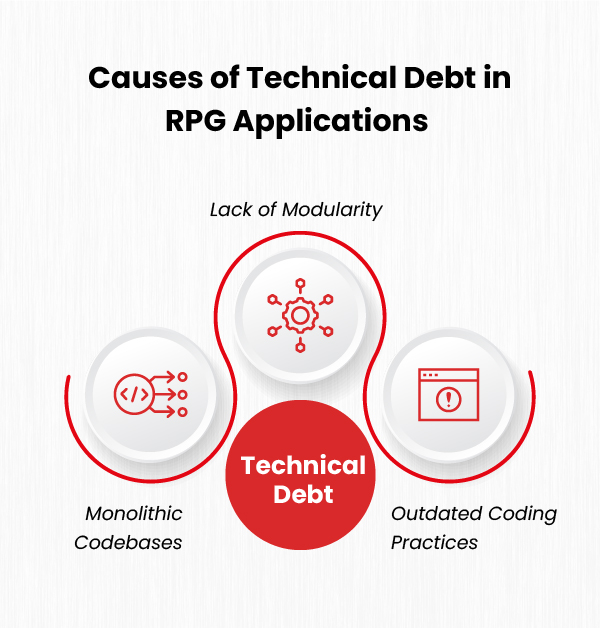
Technical debt in legacy RPG applications refers to the accumulated shortcomings in code quality, architecture, and development practices that hinder future adaptability. Over time, many RPG applications have become difficult to maintain or scale due to:
- Monolithic Codebases: Large, single-purpose programs without separation between business logic and UI logic
- Lack of Modularity: Absence of reusable components increases duplication and decreases efficiency
- Outdated Coding Practices: Many applications still use fixed-format RPG which is not only harder to read but also incompatible with modern tooling and development practices

This accumulated debt affects several aspects of IT operations.
- Maintainability suffers as new developers find it difficult to navigate poorly documented code.
- Scalability becomes limited because tightly coupled modules prevent parallel development and hinder performance tuning.
- Integration with modern platforms, such as web services, APIs, or cloud systems, becomes extremely challenging due to legacy code constraints
Understanding the roots and consequences of technical debt is a strategic necessity for long-term sustainability and the first step in building an effective modernization roadmap for RPG applications.
Strategies for Reducing Technical Debt While Preserving Logic
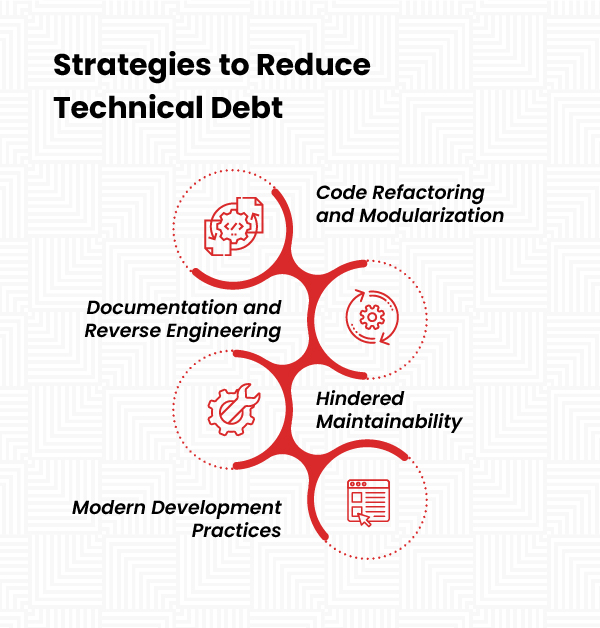
It is imperative that organizations with IBM i systems modernize their applications coded in RPG. To do so, there are tried and tested strategies that can keep the business logic intact while reducing downtime and making the process more effective and sustainable.
Practical Steps to Eliminate RPG Technical Debt
1. IBM i Code Refactoring & Auditing Dead Logic
Technical Additions: Describe auditing decades-old RPG applications to identify and strip out unused variables, dead logic paths, and duplicate database calls using automated code analysis tooling.
Auditing dead logic establishes a clean code baseline, preparing legacy programs for secure RPGLE API integration with modern SaaS tools.
2. AS400 Database Modernization: DDS to SQL DDL Conversion
Technical Additions: Detail the migration of legacy Physical/Logical Files (DDS) to SQL Data Definition Language (DDL) within DB2 for i, improving query execution speed and supporting modern indexing.
Explore SrinSoft’s comprehensive IBM i Legacy Application Modernization Services to execute seamless database migrations from DDS to SQL DDL.
3. Regression Testing Risk Reduction
Technical Additions: Explain how systematically cleaning technical debt reduces the scope and cost of regression testing during subsequent system enhancements.
Documentation and Reverse Engineering
Since legacy RPG applications often lack comprehensive documentation, modernization efforts should essentially begin with a thorough understanding of existing logic. There are tools like X Analyzer and ARCAD Observer, built specifically to help modernize legacy IBM i applications written in RPG (and COBOL).
These tools automatically generate interactive documentation like data flows, dependencies, and unused code segments. Such code analysis and documentation help to understand how a complex RPG system works and quickly identify what needs to be modernized, reused, or eliminated.
In addition to using analysis and documentation tools, creating flowcharts, logic maps, and architectural diagrams is equally important. Visualizing the code structure is useful to understand the sequence of logic and data transformations. It also helps spot bottlenecks or redundant flows and even avoid unintentional disruptions during code changes.
Testing and Validation
Robust testing is undoubtedly a critical aspect when it comes to modernizing RPG applications without altering core functionality. It is also testing that success of preserving business logic during refactoring hinges on.
Unit testing for the refactored code can be performed with testing frameworks such as RPGUnit that not only allows developers to validate individual procedures but also create repeatable, automated tests for individual procedures and modules. These tests are extremely important to ensure that refactored code continues to perform as expected.
There are test automation tools that can mimic how users and systems interact with RPG applications using real or historical input data. This gives added confidence in the business logic after refactoring the code.
Modern Development Practices
While converting fixed format RPG to free format is an effective solution, that alone isn’t enough. To extract the most out of modernization efforts, it is equally important that it is supported by modern coding practices and not just code changes.
Developing applications on RPG has historically been manual and a siloed process with several limitations like fragmented development environments, lack of automated rollbacks, no centralized changed history and many other features that modern tools offer.
These limitations can be overcome by introducing modern development practices like Git, CI/CD pipelines, DevOps integration, and modern IDEs which makes RPG modernization more efficient and future-proof.
- Git brings structure, safety, and teamwork into RPG development on IBM i, reducing risks and improving efficiency.
- CI/CD pipelines help to deploy changes faster and more reliably, with fewer manual steps.
- DevOps practices (collaboration between dev and ops teams) enable faster delivery and better quality.
- Modern IDEs (Integrate Development environments) like Rational Developer for i (RDi) make RPG development faster, more intuitive, and less error-prone, like modern programming environments.
Over and above updating the code, these practices transform the way teams write, test, deploy, and manage it.

Common Pitfalls to Avoid
Reducing technical debit in legacy RPG applications is a huge undertaking and fraught with challenges. Here are some of the common pitfalls that businesses must pay heed to.
Refactoring Without Understanding Business Rules
One of the most common and costly mistakes is altering code without fully grasping the business logic it supports. In legacy RPG applications, business logic is embedded within the codebase which is responsible for handling critical workflows.
Developers might attempt to clean up, rewrite, or modernize code without fully understanding why that logic is there or how it’s used. Making changes without understanding the real-world purpose behind the code can break critical business processes.
While refactoring the code, it is a good practice to collaborate with business users to preserve the accuracy and purpose of business logic.
Over-Reliance on Automated Tools
Modernization tools (such as syntax converters or refactoring utilities) are great for speeding up tasks like converting fixed-format RPG to free-format or analyzing dependencies.
However, these tools operate based on rules and not real-world business understanding. Human oversight is essential to catch things that tools can’t understand, like why a particular business rule exists or how different modules interact in practice.
While modernization tools are valuable for reducing manual effort, they should only support developers in their understanding of the code and not replace them. The real value comes when developers combine the speed of tools with domain knowledge and thoughtful analysis.
Ignoring User and Stakeholder Feedback
It is beyond doubt that rewriting old code or upgrading to modern tools is an essential part of modernization. However, improving how the system serves its real users is the end goal of the process.
Stakeholders, especially daily users of the system, often have deep insight into how the application is used, what workarounds exist, and where bottlenecks are.
If developers modernize the code without consulting these users, the end result might work technically but fail to meet real operational needs. Regular engagement with users helps you build a system they will actually adopt and benefit from.
Conclusion
RPG applications often contain decades of critical business rules that must not be lost. Businesses must ensure that the core logic remains stable while cleaning up the code which helps future-proof IBM i systems and prepare them for new demands, integrations, or developer turnover.
Rather than rewriting the entire system at once (which is risky), enterprises should use structured approaches and strategies that will help to modernize step-by-step and safely testing as they go.
It is important that technical debt is reduced by balancing modernization with the need for reliability, especially in mission-critical systems like those on IBM i.