






Have you ever wondered how some companies handle massive sales peaks without a single glitch while others stall for hours?
It usually comes down to the foundation. The EDI architecture.
If your business is growing, your transaction volume is likely surging. But here is the reality. Most integration systems were built for the world of 10 years ago. They were designed for small batches, not millions of real-time messages.
When traffic spikes, does your infrastructure stay steady? Or does the engine start to fail?
A constraint in your data flow is more than a minor error. It is a barrier to your revenue. It leads to missed orders and frustrated partners.
The good news is that you no longer have to struggle with legacy limits. Building a scalable, cloud-native framework can turn your data exchange from a liability into a competitive advantage.
We are going to look at exactly how to build a system that expands effortlessly.
Let’s get started.
What Does Scalability Actually Mean?
In an enterprise context, scalability is the ability to handle growth without infrastructure collapse. It is the difference between a system that expands and one that breaks under pressure.
To measure true scalability, focus on these four pillars:
- Throughput: Processing millions of messages without building a backlog.
- Partner Growth: Onboarding new entities without impacting existing traffic.
- Message Diversity: Supporting multiple data formats and protocols simultaneously.
- Resilience: Isolating failures so one corrupt file cannot crash the entire network.
How High-Volume EDI Environments Control the Flow?
In a high-volume environment, letting every transaction hit the core database all at once is a mistake. Doing that is a fast way to make the system choke.
Think of it like a crowded stadium. If everyone tries to run through one door at the same time, nobody gets in. There must be a way to manage the flow.
Modern EDI architectures use a few specific techniques to keep things moving:
1. The Buffer (Queuing) Instead of trying to process a file the second it arrives, the system drops it into a queue. It’s basically a waiting room. This catches the surge and feeds it into your engine at a speed your ERP can actually handle.
2. Receipt First, Work Later (Asynchronous) The system tells the partner “Got it” immediately. Then, it does the heavy lifting, like mapping and translating in the background. This keeps the “front door” open so you can keep taking in new orders while the system works on the old ones.
3. Isolation (Decoupling) Each step is separate. Receiving, validating, and translating are all independent. If the validation step slows down, it doesn’t stop you from receiving new files.
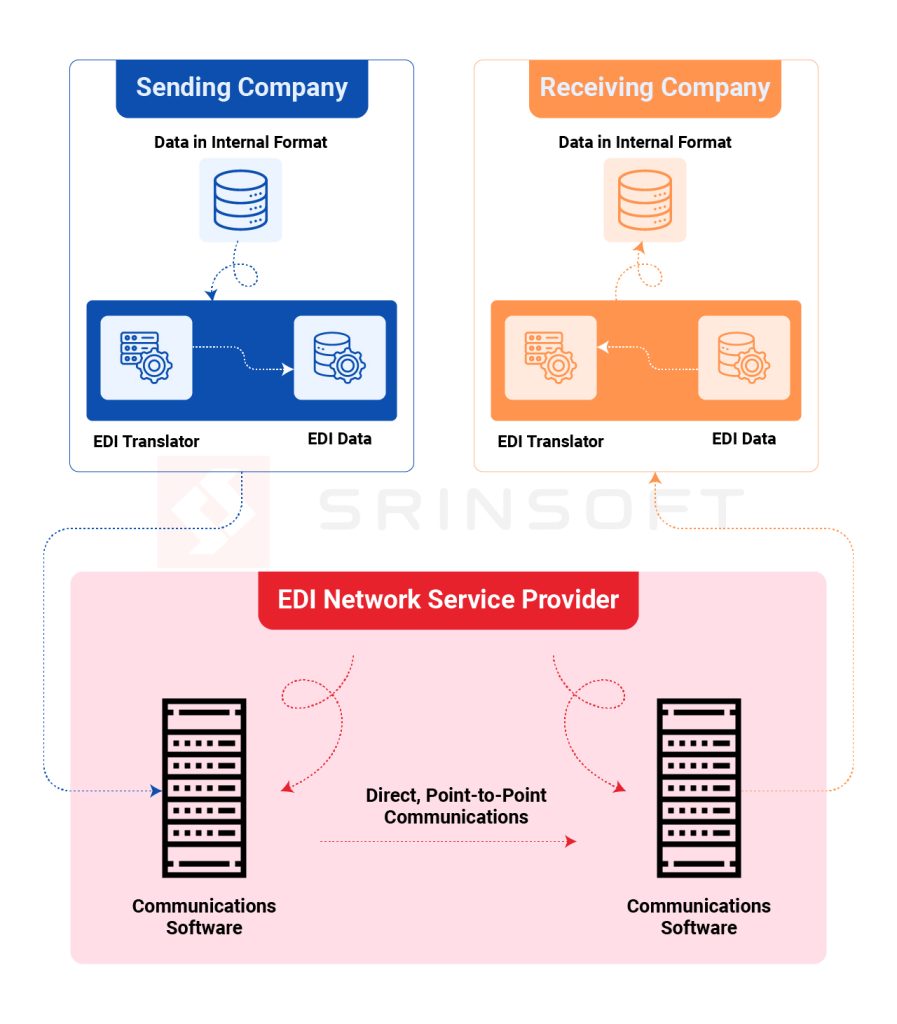
Which EDI Architecture Patterns Scale Without Increasing Operational Risk or Complexity?
Choosing an architecture is about how much risk the business can tolerate. To scale without adding massive complexity, the design needs to move away from rigid, one-to-one connections.
Here are the 3 main patterns that high-volume enterprises use to keep their balance:
Centralized Hub-Based Models
Think of this as an air traffic control tower. Instead of every trading partner connecting directly to your internal systems, everyone connects to a central hub.
- Better Governance: You apply security rules and audit transactions in one place.
- Simplified Standards: It reduces the headache of managing hundreds of different partner formats.
Event-Driven and Message-Oriented Architectures
This is where true high-volume scaling happens. In an event-driven setup, the system reacts to “events” like an order arriving. It does not wait for a manual prompt.
- Message Brokers: Data sits in a queue until the next service is ready. This acts as a massive safety net.
- No More Crashes: If your translation engine slows down, messages just wait in the broker. Nothing gets lost.
- High Throughput: The system can handle a sudden surge because it is not forced to process everything in a linear line.
Hybrid and Transitional Architectures
Modernization does not happen overnight. Most large companies cannot simply turn off their legacy systems. This is where hybrid patterns come in.
- Coexistence: A modern, cloud-native engine sits alongside your older on-premise system.
- Smart Routing: You can move high-volume traffic to the cloud while keeping low-volume partners on the legacy side.
When Do Cloud or Hybrid Models Make Sense for Scalable EDI Operations?
Once you settle on an architecture pattern, the next big question is where that system actually lives. Do you move everything to the cloud, or do you keep your servers under your own roof?
It is a business decision based on how much control you need versus how much speed you want.
Here is how to decide which path makes the most sense for your operations:
When to Go Fully Cloud-Native
If your business experiences massive, unpredictable spikes in traffic, the cloud is usually the winner.
- Elasticity – The system grows automatically when a surge of orders hits and shrinks when things quiet down. You aren’t paying for empty server space.
- High Availability – Cloud providers spread your data across multiple regions. If one data center goes dark, your EDI flow stays online.
- Cost Predictability – You trade massive upfront hardware costs for a steady, monthly operating expense.
The Case for the Hybrid Model
Despite the hype around the cloud, many enterprises stick with a hybrid approach. This is common if you are running on-premises ERPs or legacy systems like IBM i that aren’t easy to move.
- Legacy Constraints: If your core data lives on a local server, a hybrid model keeps the heavy lifting close to the data to avoid latency issues.
- Compliance and Regulation: In some industries, data laws require you to keep certain records on your own hardware. Hybrid gives you cloud speed while keeping sensitive data under your direct lock and key.
- The Best of Both Worlds: You can use the cloud to handle the messy partner connections and translations, then send the clean, finalized data back to your local system.
How to Handle High Transaction Spikes Without System Failure
When your business grows, your EDI system faces more pressure. During peak times like a big sale or the end of a month, your transaction volume can jump 500 percent in an hour. If your system is not built to scale, it will crash. This stops your orders and hurts your revenue.
The best way to fix this is to use a Message Queue.
- Create a Buffer: Instead of sending data directly to your ERP, you place it in a queue like Kafka or Azure Service Bus. This acts as a storage tank. It collects the data and lets your system process it at a safe speed.
- Use Auto-Scaling: Use cloud technology to spin up extra ‘translators’ only when you need them. When the rush is over, these extra resources turn off. This keeps your costs low while keeping your speed high.
- Isolate Errors: If one file is broken, your system should move it to a separate folder called a Dead Letter Queue. This ensures that one bad order does not block thousands of good orders from going through.
Maintaining Visibility and Governance at Scale
As transaction volume increases, manual monitoring becomes impossible. You must move to an automated observability stack to maintain your SLAs and ensure data integrity across the network.
- Implement Centralized Logging: Move away from local file logs. Use a stack like ELK (Elasticsearch, Logstash, Kibana) or Splunk to aggregate all EDI events. This allows you to run complex queries across millions of rows of data in seconds.
- Monitor Transaction Latency: Track the time between the ISA header receipt and the final 997 Functional Acknowledgment. Set up automated alerts for any transaction that exceeds your defined SLA threshold.
- Role-Based Access Control (RBAC): As the environment grows, you must enforce strict governance. Use RBAC to ensure only authorized users can view sensitive PII or PHI data within the EDI payloads.
- Real-Time API Health Checks: If you use a hybrid model, monitor the heartbeat of your secure tunnels and API endpoints. This prevents silent failures where the EDI gateway is up but the back-end ERP connection is down.
Closing Thoughts
Let’s be honest. You can keep patching your legacy system. You can keep paying those escalating VAN fees and crossing your fingers every time peak season rolls around.
But hope is not a strategy.
If you want to scale truly scale, you have to stop thinking of EDI as just ‘boring plumbing.’
In 2026, The companies that win are the ones that can onboard partners in days, not months. They are the ones that can handle a 10x surge in orders without their ERP breaking a sweat.
The choice is yours:
- You can stay rigid and risk a ‘revenue choke point’ during your next big growth spurt.
- Or, you can build a resilient, event-driven architecture that turns your supply chain into a growth engine.
Are you ready to stop managing files and start managing growth?
Is Your EDI Architecture Holding You Back?
We’ve helped some of the biggest names in the industry move from legacy lag to high-volume efficiency. If you’re tired of EDI being the bottleneck in your business, let’s fix it.
FAQ’s
What business risks emerge when EDI systems fail to scale with transaction growth?
When your system can’t scale, you start seeing dropped orders or delayed invoices. This leads to missed shipping windows and expensive chargebacks from your partners, which directly hurts your revenue and your professional reputation.
How can CIOs assess whether their current EDI architecture has reached its limits?
Check your processing times during peak hours. If your CPU usage is constantly pinned at 100% or the time it takes for an order to hit your ERP is increasing as you add partners, your architecture is maxed out and likely to fail soon.
What are the long-term cost implications of scaling EDI on legacy architectures?
Scaling legacy systems is a money pit because you have to keep buying more hardware. You end up paying for huge server capacity all year long even though you only actually need that extra power for a few days of peak volume.
How do scalable EDI architectures support compliance and audit requirements?
Modern systems use centralized logging to track every movement of a file. This makes it much easier to pull reports for SOC2 or HIPAA compliance because all the data is in one searchable spot instead of being scattered across different old servers.
When should enterprises re-architect EDI instead of incrementally optimizing it?
If your team spends more time fixing system stalls and technical debt than onboarding new partners, it is time to start over. When the cost of keeping the old system alive is higher than moving to a cloud-native setup, re-architecting is the smarter move.