






You are not behind because you made bad decisions. You are behind because the safe decision had a hidden cost.
Here is the uncomfortable truth nobody in your IT team wants to say out loud.
That IBM i system running your core operations? It works. It has always worked. And that reliability is exactly why nobody has touched it — and exactly why you are now stuck.
Did you know?
The cost of delaying IBM i modernization costs roughly 15% more annually in maintenance and support fees, with modernization costs projected to be 40–60% higher if postponed past 2027. Further, 80% of IT budgets can be consumed by legacy maintenance (“legacy tax”), alongside rising security risks—44% of which target older applications.
Your marketing team wants AI personalization. Your logistics team wants real-time tracking. Your developers want to ship faster. But every single one of those initiatives hits the same wall: a core system that was never built to talk to the modern world.
So you build workarounds. You hire expensive specialists. You delay the AI project. Again.
The Cost of Delaying IBM i Modernization is not coming. It is already here — buried in your maintenance budget, your hiring costs, and every initiative that stalled before it started. How much has waiting already cost you?
The Modernization Mandate
IBM i modernization is not about replacing what works. It is about making what works connect to everything else.
Your core business logic, the pricing rules, inventory controls, and transaction workflows that have run reliably for decades, still has value. The problem is that modern tools, including AI engines, cloud platforms, and customer-facing applications, cannot easily talk to it. That gap creates manual workarounds, integration debt, and a ceiling on how fast your business can move.
When your teams cannot access real-time data without a custom export, or when a new digital initiative stalls because it cannot connect to your core system, modernization stops being optional. It becomes the price of staying competitive.
Why Should Businesses Modernize IBM i now?
Waiting to modernize is not a strategy. It is a debt. And in 2026, that debt is coming due faster than most organizations planned.
The talent cliff is no longer a future threat. The people who wrote your core RPG code are retiring. By the end of last year, a quarter of the senior IBM i workforce left the market. This means you are losing undocumented knowledge every month. Recruiting specialized talent now costs significantly more than hiring modern engineers. You must move your logic into languages that the next generation of developers actually speak.
You cannot run 2026 AI on 1996 code. Monolithic applications hide data in silos that AI agents cannot reach. Addressing technical debt before starting AI projects can boost your ROI by nearly 30%. Cleaning up your code today is the only way to make your AI initiatives profitable tomorrow.
The integration wall is blocking your growth. Your customers expect real-time updates, but your legacy system was built for batch processing. Manual workarounds and “wrappers” create lag and errors. Most IT leaders agree that integration issues are the primary barrier to growth. IBM i modernization urgency is about moving to an API-first model so your core system talks to the rest of the world instantly.
Maintenance is a money pit. Keeping the lights on is eating your innovation budget. Up to 80% of IT budgets are currently swallowed by legacy maintenance. This “Legacy Tax” leaves zero room for projects that grow revenue. IT cost optimization starts by reducing the complexity of your environment to free up capital.
Cyber resilience is non-negotiable. Legacy systems are reliable, but their middleware often is not. Hackers are now using AI to find holes in old authentication protocols. Attacks on legacy-targeted applications have risen by 44% recently.
The Real Cost of Waiting
Doing nothing feels like a safe choice. It is not. It is a bet that the cost of inaction stays lower than the cost of change. In 2026, that bet is losing.
Most organizations believe they are avoiding risk by not modernizing. What they are actually doing is paying a Legacy Tax that compounds every month. Think of it like carrying a balance on a high-interest credit card. The longer you wait to pay it down, the more the interest costs relative to what you originally owed.
Here is what that looks like in terms of real money and risk:
| The Problem | What it Costs You (Data-Driven) | Why it Matters |
| The “Keeping the Lights On” Tax | 70% to 80% of your IT budget. | You have almost no money left to build new things or use AI. |
| The AI Performance Gap | 29% lower ROI on AI projects. | Your new AI tools can’t “talk” to your old code, causing massive friction. |
| The Skills Cliff | 30%+ higher salaries for RPG experts. | The people who know your system are retiring. Finding replacements is getting nearly impossible. |
| The Delay Penalty | 20% to 25% cost increase per year. | The longer you wait to fix the code, the more complex and expensive the project becomes. |
| The Security Target | $4.44 Million (avg. breach cost). | Hackers now use AI to find holes in legacy systems that weren’t built for 2026 threats. |
How to Modernize IBM i Without Betting the Business?
The most expensive mistake? Treating this as a single large project.
Learn how to plan your investment wisely in our guide: How to Perform IBM i Modernization Smartly and Within Budget.
Big-bang replacements that promise results in two years lose executive support, blow budgets, and exhaust teams before anything ships. The approach that works is phased — built to show measurable returns every quarter.
Step 1: Map before you move
You cannot modernize what you do not understand.
Run an automated assessment before writing a single line of new code. You are looking for three things:
- Which RPG programs are still doing real work
- Which ones have not been called in years
- Which integrations are held together by undocumented workarounds
That last category is where the surprises live.
“In our experience / based on client assessments, automated audits typically find that 33% of in-scope code is dormant — which reduces project scope and cost before work even begins.”
Step 2: Build the case in business language
Two ways to ask for the same budget:
“We need to refactor RPG to Java.” — Answer: no.
“We can reduce maintenance costs by [X]% and enable AI-driven logistics within 12 months.” — Answer: tell me more.
Same project. Completely different conversation. Frame your business case around questions your CFO already loses sleep over:
- What does a legacy-targeted breach cost us in our industry?
- How many months of revenue are we losing to manual integration delays?
- What happens when our last three RPG specialists retire and that knowledge walks out with them?
These are not IT questions. They are business continuity questions. Treat them that way.
Step 3: Phase the work, build the momentum
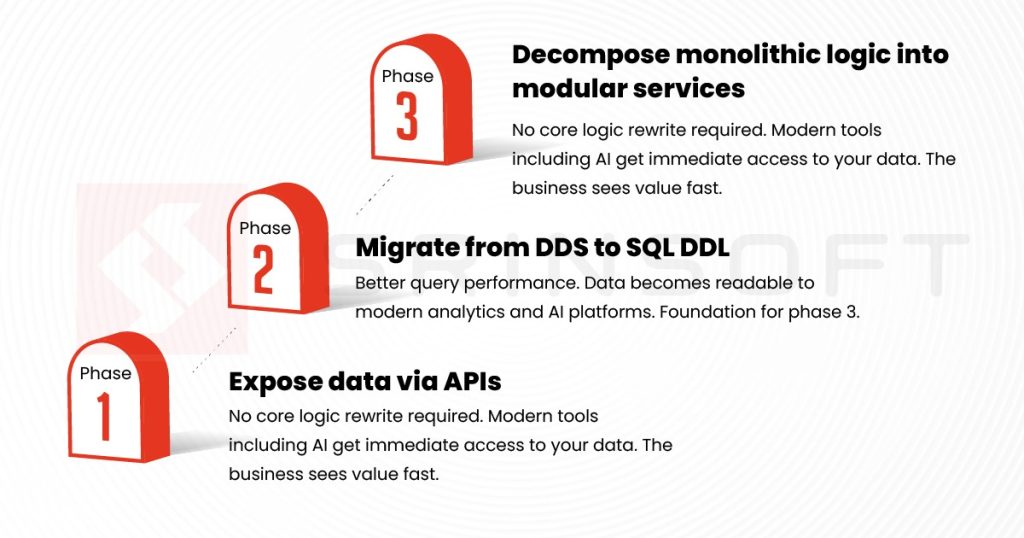
Do not move everything at once. The sequence below is proven for IBM i environments:
Phase 1 — Expose data via APIs. No core logic rewrite required. Modern tools including AI get immediate access to your data. The business sees value fast.
Phase 2 — Migrate from DDS to SQL DDL. Better query performance. Data becomes readable to modern analytics and AI platforms. Foundation for phase 3.
Phase 3 — Decompose monolithic logic into modular services. The most complex phase. Only begin once phases 1 and 2 are stable.
“Not sure which tools to use for each phase? Explore our Top 10 AS400 Modernization Tools in 2026 to match the right solution to every stage of your roadmap.”
One thing the roadmap cannot fix on its own
Modernization will change how your teams work. Developers who have spent years in “do not touch what is working” mode need to shift toward continuous improvement. That is a change management problem, not a technical one.
It needs executive sponsorship. Not a memo. Not a slide deck. Visible, sustained commitment from leadership that this is a business priority — not an IT project running quietly in the background.
Get that right and the roadmap works. Without it, even a well-scoped technical plan stalls.
The ROI of Action: Beyond “Keeping the Lights On”
Stop looking at modernization as a cost. Look at it as an arbitrage trade.
You are exchanging high-cost, low-yield legacy maintenance for faster operations, cleaner data, and development teams that can actually move. The table below shows what that trade looks like in financial terms across five impact areas.
All figures are industry benchmark ranges. Sources marked for verification before publication.
| Benefit Category | Expected Financial Impact (2026 Benchmarks) | The “Why” Behind the Number |
| Operational Savings | 30% to 50% reduction in maintenance costs. | Automated testing and cleaner code mean your team stops fixing the same bugs every week. |
| AI Yield Optimization | Up to 29% increase in AI project ROI. | Your data is no longer “locked” in monolithic blocks; AI agents can actually use it in real-time. |
| Developer Velocity | 40% to 60% faster release cycles. | Moving to free-form RPG or Java allows your team to use modern DevOps tools instead of manual patching. |
| Infrastructure Efficiency | 15% to 35% annual savings. | Shifting to hybrid cloud or managed Power systems eliminates the overhead of aging on-premise hardware. |
| Talent Cost Control | 25% reduction in training/onboarding time. | New hires can jump into the codebase immediately without needing a 6-month “RPG history lesson.” |
The Bottom Line
The performance gap between organizations that have modernized and those that have not is no longer theoretical. It shows up in budget lines.
Organizations still running unmodified legacy environments spend an estimated $40,000 per year, per application just to keep those systems operational. That capital is not generating growth. It is covering the cost of standing still. Meanwhile, companies that have redirected that spend are investing in AI-driven automation, real-time data pipelines, and cloud-native architecture that compounds in value over time.
The window for catching up is narrowing. When your core business logic cannot connect to the platforms your customers and partners now expect as standard, the cost is not just operational. It is competitive.
The question for your next planning cycle is not whether to modernize. It is whether the cost of waiting another year is one your business can absorb.
Ready to see what modernization actually costs — and what it returns?
We will map your environment, identify your highest-cost inefficiencies, and give you a phased roadmap in 2 weeks. No commitment is required.