







You might ask: “Why should I integrate my EDI with Dynamics GP? Our current process works fine.”
It’s a fair question. Your current process, EDI and Dynamics GP running side by side (but not integrated), is your backbone, a workhorse which has run efficiently for years supporting your business. It’s strong and gets the job done; we get that, but it’s limited to the ground.
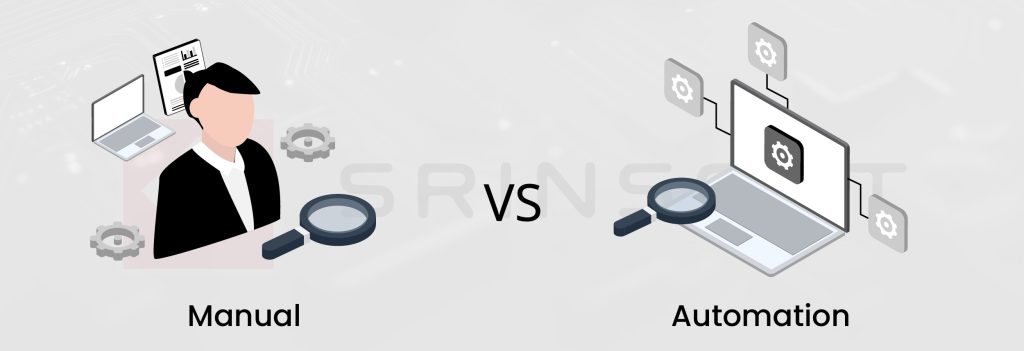
Your separate, standalone EDI is like; you receive electronic documents from your partners, your employees still manually retrieve that information and enter it into your internal business system. For a 500-line order, this can take hours; and every keystroke is a potential error.
On the other hand, automated integration of EDI with Dynamics GP gives your workhorse wings to fly, with a built-in flight tracker, transcending the slow, manual process. You gain speed, efficiency, and the ability to operate above the ground-level problems.
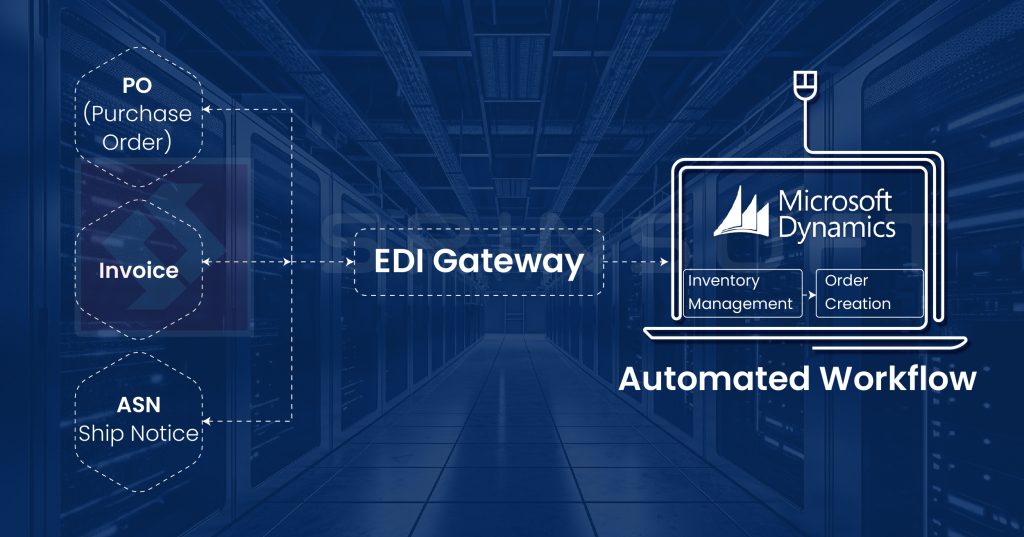
How Integration with GP Works: For example, when a retailer sends a purchase order via EDI, the document automatically flows into Dynamics GP. The system instantly creates a sales order, eliminating manual entry and transcription errors. It provides real-time inventory updates, and you avoid overselling or stockouts.
To put it plainly, it’s like upgrading your flight journey from Economy to Business Class!
This guide provides a professional, high-level overview of how to successfully integrate EDI with Dynamics GP, keeping your business agile and competitive.
Why Companies Delay Integration (and Why It No Longer Makes Sense)
Even for organizations that already use both EDI and Dynamics GP, integration often gets pushed down the priority list. Common reasons include:
- “Integration sounds expensive.”
In the past, custom projects were costly. But with today’s GP add-ons and cloud-based platforms, Dynamics GP EDI automation is more cost-effective than maintaining inefficient manual processes. - “It seems complex and risky.”
Leaders often fear downtime or compliance issues. In reality, structured rollouts and proven partner methodologies reduce risk and ensure business continuity. - “We’ve been managing with workarounds.”
Semi-automated processes like batch uploads or scripts mask inefficiencies but prevent true real-time visibility and error reduction. - “We don’t have internal IT bandwidth.”
Modern integration solutions often shift the burden to managed service providers, freeing internal IT to focus on higher-value initiatives. - “We thought Dynamics GP didn’t support EDI.”
Dynamics GP doesn’t have native EDI, but proven add-ons and platforms now make integration straightforward and scalable. - “We were waiting for an ERP upgrade.”
Many companies delay, assuming integration won’t carry over. In reality, EDI integrations can be designed to migrate smoothly when upgrading to newer ERP systems.
What is Electronic Data Interchange (EDI)?
EDI is the standardized method of exchanging the entire procure-to-pay (P2P) and order-to-cash (O2C) cycles documents (POs, invoices, ASNs, etc.) between trading partners within a supply chain.
Why Integration Matters
If your company already runs EDI and Dynamics GP, you’re halfway there. But without direct integration, challenges remain:
- Slow Transaction Cycles
- Error-Prone Processes:
Example: A warehouse team ships 100 units, but someone mistypes “1,000” while entering the shipment into GP. The EDI system sends incorrect data to the trading partner, resulting in chargebacks, penalties, or even a strained relationship.
- Limited Visibility:
Example: An executive wants to know the real-time status of all open orders with a top partner. But because EDI transactions and GP data live in separate systems, reports are outdated or incomplete. Leaders are left making decisions based on yesterday’s numbers.
Modern benefits: Moving beyond paperless
While a common perception is that EDI is simply about going “paperless,” modern EDI automated integration with ERP systems delivers far more profound business value:
- Reduced Costs: Executives often assume that connecting EDI to Dynamics GP requires a costly custom project, when in reality, scalable third-party solutions or add-ons often lower long-term costs
- Accuracy: Direct system-to-system exchange leads to more accurate financial reporting and inventory management.
- Enhanced Speed and Efficiency: Orders, invoices, and shipments are confirmed instantly.
- End-to-End Visibility: A single, centralized dashboard for tracking the status of every transaction. You get end-to-end log visibility into the supply chain
- Scalability: New trading partners are onboarded effortlessly with no increase in manual workload.
Common Integration Approaches
Companies with existing EDI systems have multiple pathways to integrate with Dynamics GP. Each comes with its own trade-offs:
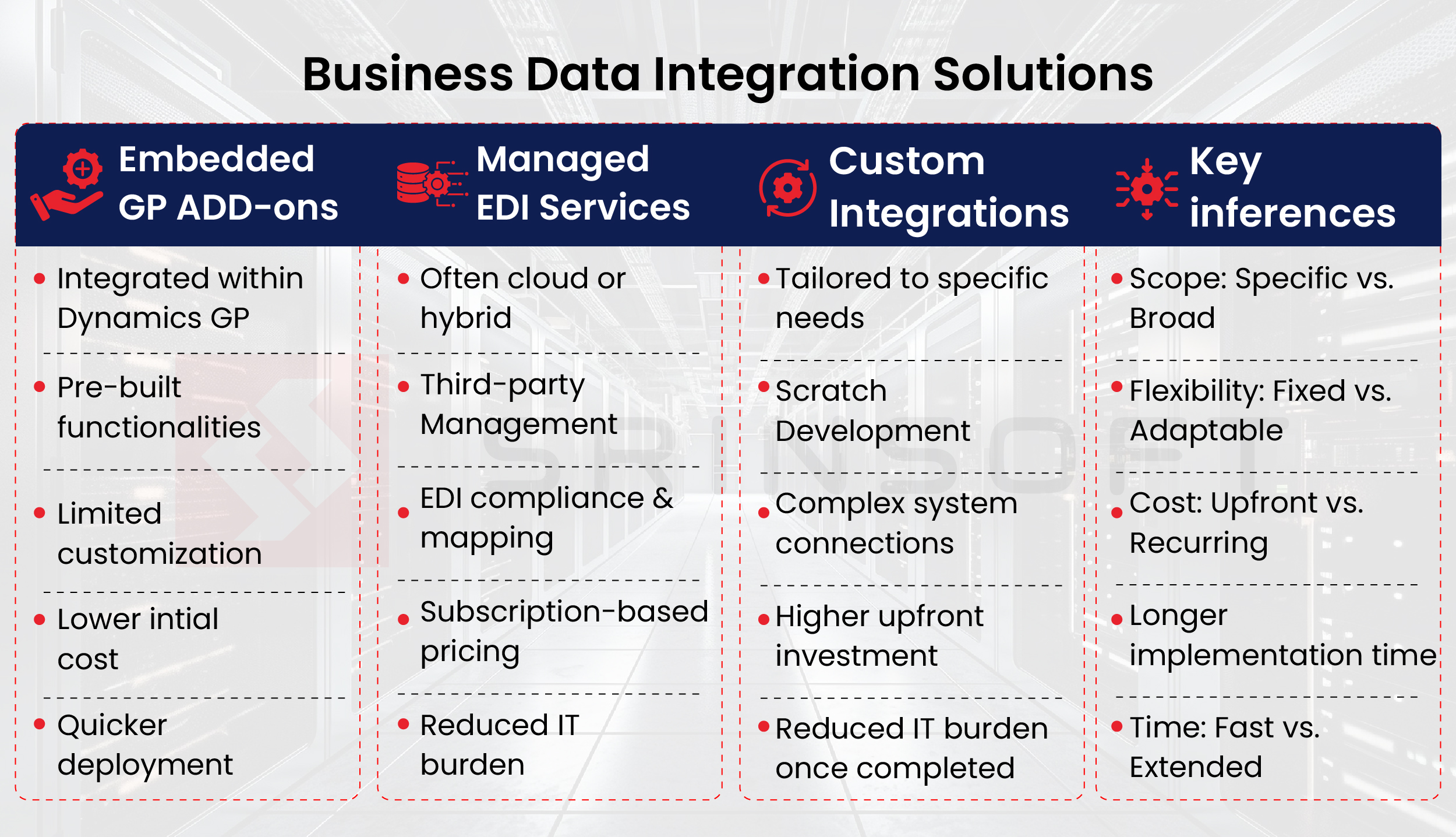
- Embedded EDI Add-Ons for GP
Think of GP-specific EDI add-ons as adding a new gear to an already well-oiled supply chain machine. These are ideal if you want tight integration without heavy IT maintenance. For a distributor, using a GP add-on, incoming purchase orders flow directly into GP sales order entry, while outbound invoices are generated and sent automatically.
- Managed EDI services (EDI as a Service)
EDI service providers already manage translation, compliance, and partner connectivity. A managed EDI service provider acts as an outsourced EDI department, handling all the technical complexities.
- The provider manages all aspects of the integration, from data mapping and translation to connecting with your trading partners via a Value-Added Network (VAN) or direct protocols like AS2.
- They manage ongoing changes to your trading partners’ requirements, ensuring continuous compliance without taxing your internal IT resources.
- It’s an agile, scalable model that is well-suited for businesses with complex or high-volume EDI needs.
- Custom Point-to-Point Integration
For example, a specialty automotive parts supplier has complex pricing rules that don’t fit standard EDI templates. Their IT team builds a custom integration that maps EDI 850 orders directly into GP sales order processing, applying pricing logic on the fly.
⚠ Caution: It works exactly how they need, but every time a partner changes its EDI format, the IT team must update the custom scripts, increasing your total cost of ownership.
How Integration Works: Key Steps
- Planning & Requirements Gathering
- Identify trading partner formats and compliance rules.
- Clarify business goals: speed, cost reduction, error elimination, visibility.
- Assess transaction volumes and growth projections.
- Mapping EDI to GP Data
- Automate EDI mapping in GP to remove manual intervention.
- Testing & Validation
- Validate mappings with sample transactions.
- Run parallel testing with live data before going full scale.
- Establish error-handling processes to manage exceptions.
- Monitoring & Compliance
- Use dashboards for EDI visibility in Dynamics GP.
- Track order statuses in real time across both systems.
- Stay ahead of compliance changes by automating updates.
Conclusion: Turning Two Investments into One Strategy
If you’re experiencing the following issues, now is the perfect time to integrate your EDI with Dynamics GP:
- Performance Woes: If your EDI system is feeling slow and even simple tasks seem to take forever.
- Customization and User Fatigue: An excessive amount of customization mixed with standard code confuses consumers and leads to issues.
- Lack of New Features: When you realize that your system lacks latest tools for collaboration.
- Looking into the Future: If EDI’s limits become apparent to you as your company grows or expands into new markets.
By connecting what you already own—EDI and Dynamics GP—you unlock the full potential of both, positioning your organization for efficiency, agility, and long-term success.
We’d welcome the opportunity to assess how EDI-GP integration aligns with your strategic objectives
Why Consider SrinSoft Technologies as Your Integration Partner?
- 20+ Years of Experience – Proven expertise in ERP and EDI integration across industries.
- 750+ Associates Worldwide – A strong global delivery team ensuring scalability and round-the-clock support.
- Trusted by Industry Leaders – Serving A-list clients in manufacturing, retail, transportation, logistics, and more.
2026-Ready EDI + Dynamics GP Services:
- Next-Gen EDI System Upgrades
- Proactive Security & Continuous Monitoring
- Intelligent Trading Partner (TP) Mapping
- Strategic Workflow Automation
- Analytics & Real-Time Visibility Dashboards