







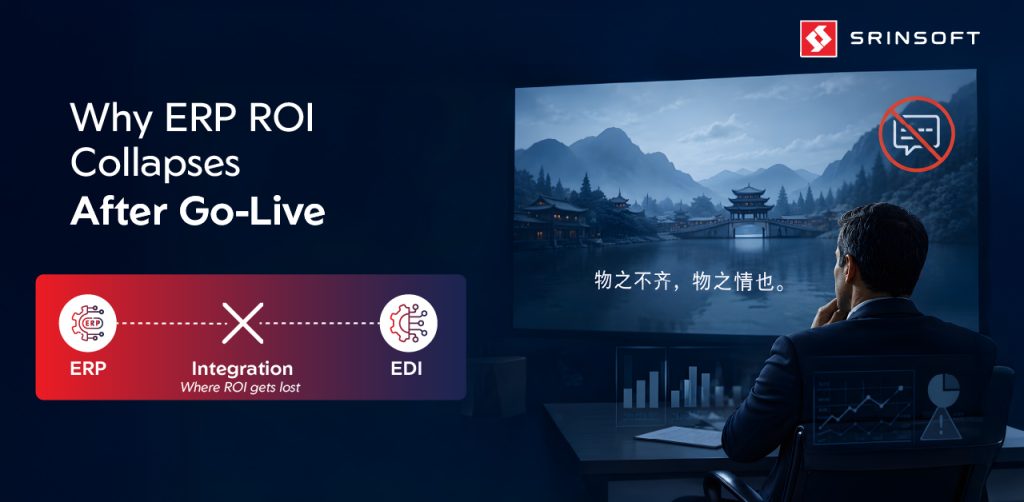
Imagine watching a foreign-language film with no subtitles.
The story is all there, but most of it never reaches you.
That’s your ERP right now.
You invested in and implemented the ERP. But without ERP EDI integration connecting your systems to the outside world, the data sits there, complete, but silent. The ROI you were promised stays just out of reach.
Why Most ERP EDI Integrations Quietly Underperform
The edge cases multiply faster than you planned. Every trading partner has quirks. Transactions that pass validation still get rejected. Each exception is small, but at volume, these edge cases become a full-time job your team didn’t sign up for.
The ERP was customized to fit the old process. Over-customization locks you into workarounds that made sense at go-live and become liabilities the moment a trading partner changes a requirement. What was built for flexibility becomes the biggest source of friction.
ERP EDI Integration had no clear objectives from the start. Without defined success metrics — transaction accuracy rates, exception thresholds, acknowledgment timelines — there’s no way to know what “working” actually looks like.
IT and operations never shared the same project. Siloed implementation teams hand off a technically functional system that doesn’t match how the business actually runs. The gaps surface post-go-live, when fixing them is most expensive.
Post-go-live monitoring was treated as optional. Silent failures are the costliest kind. Acknowledgments that never arrive. Control numbers that drift. Transactions that clear your system but never reach your partner. Without guardrails and real-time visibility, you don’t know you have a problem until a partner calls.
The total cost of integration was underestimated. The platform was budgeted. The ongoing management — exception handling, partner onboarding, compliance updates — wasn’t. That gap compounds annually.

EDI Integration with Legacy ERP – What Goes Wrong
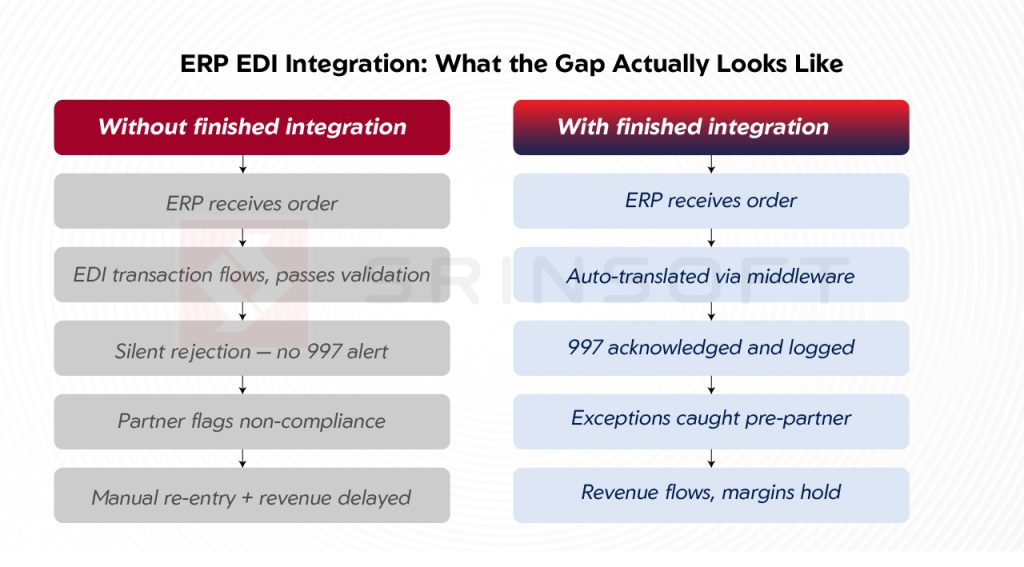
A mid-size distributor running IBM i was live with a major retail trading partner — full EDI setup, 850s flowing, system technically operational. This is a pattern we see repeatedly with EDI integration with legacy ERP environments: everything appears functional on the surface. In reality, purchase orders were passing internal validation and still getting rejected on the retailer’s end.
The culprit was control number drift — a single unmonitored guardrail in the EDI layer. Nobody caught it because nobody was watching for it.
By the time the rejections surfaced, three weeks of purchase orders had to be manually re-entered and resubmitted. The operational cost was real. The relationship cost was worse. The retailer flagged them as a non-compliant supplier, triggering a formal compliance review that pushed the next buying cycle back by a quarter.
This is what underperforming EDI integration with legacy ERP actually costs — a number that shows up in revenue, in partner scorecards, and in the pipeline your CFO is trying to explain.
The Decisions You’re Making on Bad Data
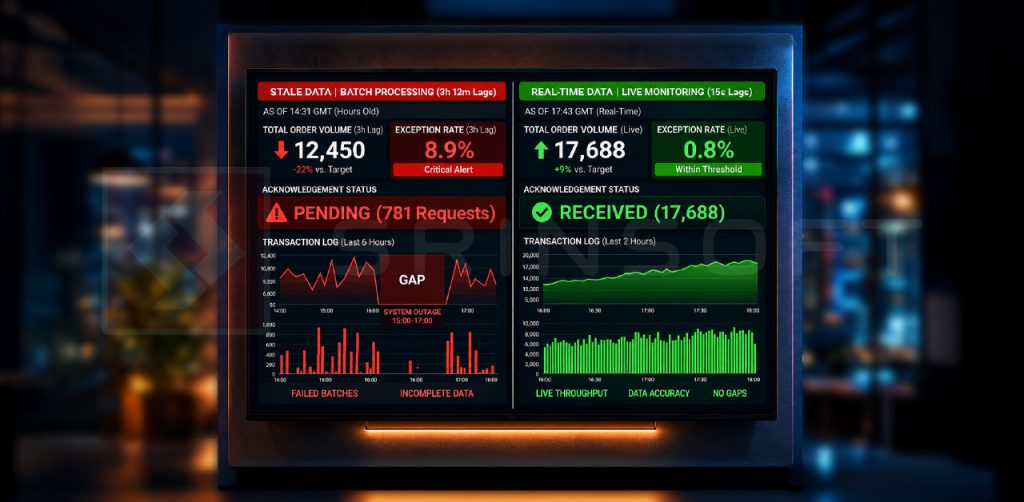
Your ERP becomes the system of record for inventory positions, order status, and fulfillment capacity — the numbers leadership uses to plan, commit, and forecast. But if that data is hours or days behind reality because transactions aren’t flowing cleanly, you’re making strategic commitments the business can’t back up.
Overselling capacity you don’t have. Forecasting demand your supply chain can’t meet. Approving growth plans built on numbers that don’t reflect what’s actually moving through your system.
The integration gap is a data integrity problem, and it sits at the foundation of every decision your leadership team makes.
What is “Finished” Integration
Finished integration means transactions flow without a human in the middle. Exceptions are caught before they reach your trading partner. And your ERP data is clean, real-time, and decision-ready.
The competitive gap here is real. Companies that have this right are winning larger retail accounts because they can meet compliance requirements without friction. They’re scaling transaction volume without scaling headcount. They’re absorbing partner requirement changes — updated ASN specs, new acknowledgment rules, revised mapping — without a crisis.
Your faster-growing competitors aren’t doing more. They’re simply losing less time, revenue, and customer trust to broken integrations.
Finished integration is when your systems stop being the reason deals slow down.
EDI Middleware Performance Issues – Why This Requires More Than a Software Upgrade
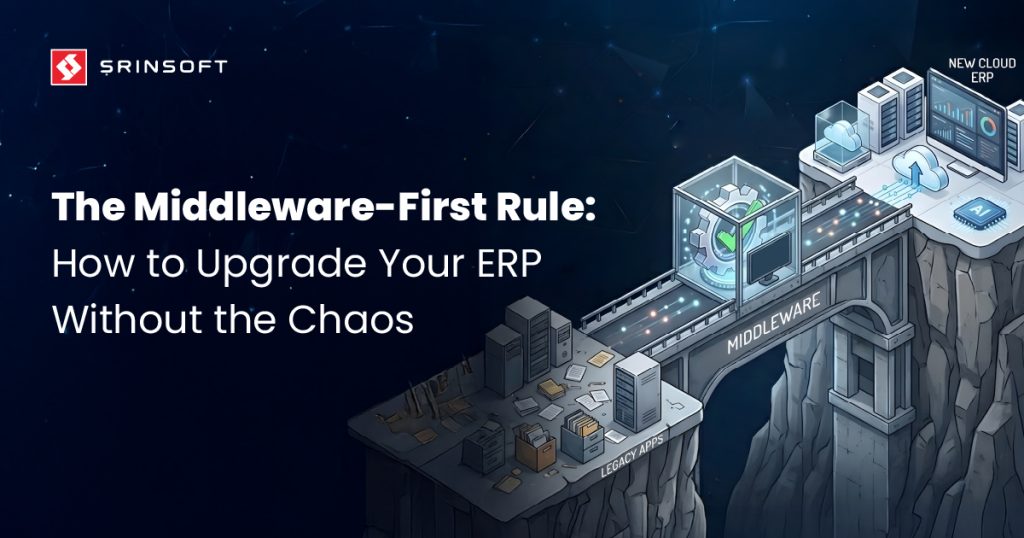
Layering new middleware for ERP on top of a broken integration foundation doesn’t close the gap. The underlying issues — untracked control numbers, missing acknowledgment loops, absent pre-ERP validation, partner-specific mapping built on assumptions that are now years out of date — don’t disappear because a new platform sits above them. They resurface, usually at the worst possible moment: a new partner onboarding, a peak season volume spike, a trading partner audit.
The integration layer has to be structurally sound before anything else scales on top of it. That means going back to the foundation — not to rip it out, but to finish what was never completed at go-live.
Why SrinSoft for ERP and EDI Integration Solutions
Most firms that offer ERP and EDI services treat them as separate practices. The problem lives in between them, which is exactly where generalists struggle.
Srinsoft has spent 21 years working inside environments where ERP, EDI, and middleware aren’t three separate conversations. They’re one. That depth matters when the issue isn’t the software; it’s the decade of accumulated workarounds, undocumented partner mappings, and integration logic that only two people in your organization still understand.
The work Srinsoft does is completion — finishing the integration layer that was scoped down at go-live, never revisited, and has been quietly creating exceptions ever since. For organizations in retail, distribution, logistics, and manufacturing, where trading partner compliance is non-negotiable, that distinction matters.
Srinsoft’s partnership with Cleo brings any-to-any integration capability directly into the IBM i stack — without disrupting core operations. We are trusted by companies like NASA, GE, and Disney; not just names on a client list. They’re evidence that we have operated where the cost of getting integration wrong is already priced in.
If your ERP and EDI investment isn’t returning what was promised, the gap is almost never the platforms. It’s the layer in between; and that’s precisely where Srinsoft works.
ERP EDI integration ROI – The Integration Gap Won’t Close Itself
Every quarter you run on an incomplete integration layer is a quarter of revenue delayed, exceptions managed manually, and trading partner trust slowly eroding.
The systems you invested in are capable of delivering what was promised. The foundation just needs to be finished.
Srinsoft offers a no-obligation integration assessment for IBM I environments; a direct look at where your ERP-EDI stack stands today, where the gaps are, and what closing them is actually worth to your business.
Just an honest read on where you are and what it takes to get the return you were promised.
Request Your Integration Assessment →
Frequently Asked Questions
Why is my ERP not giving me the ROI we were promised?
Because the ROI depends on clean, automated data flow between your ERP, your trading partners, and your internal systems. The ERP is only part of the solution. Without finished EDI and middleware EDI integration, the investment is incomplete.
How do I know if our EDI integration is actually working or just running?
If your team is manually intervening in transactions, chasing acknowledgments, or finding out about rejections from trading partners before your own system flags them; it’s running, not working.
What’s the actual cost of not fixing this?
Delayed revenue, chargebacks, manual headcount, and trading partner relationships that erode until a key account flags you non-compliant.
Can we just add a new middleware tool on top of what we have?
No. New tools on a broken foundation bury the problem. Fix the integration layer first, then build on it.
How long does it take to actually fix ERP-EDI integration without disrupting operations?
Depends on scope, but the right approach closes gaps methodically while operations continue. The risk is waiting, not fixing.