[ Sep
14-17
] Save the date for inPOWER 2026
[ Sep
14-17
] Save the date for inPOWER 2026
 Email:
inquiry@srinsofttech.com
Email:
inquiry@srinsofttech.com Phone:
+1 614-468-8980
Phone:
+1 614-468-8980








How much time did your team waste fixing broken integrations last week?
Be honest.
If you are running on legacy EDI systems, the answer is probably “way too much.”
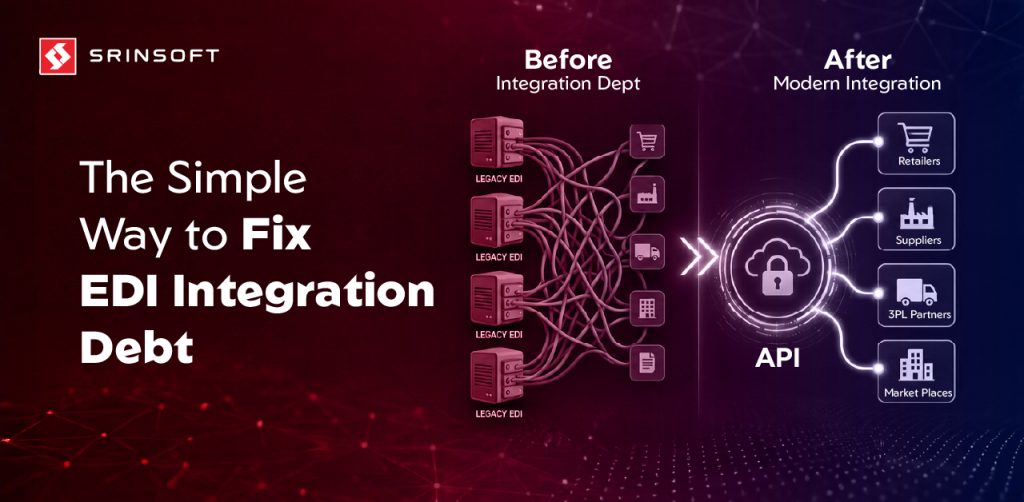
Every time you onboard a new trading partner, you build another custom connection. Every time a format changes, something breaks. It is a never-ending cycle of manual fixes.
In the tech world, we call this EDI integration debt. And if you are in supply chain, retail, or manufacturing, it is quietly eating your bottom line alive.
But it doesn’t have to be that way.
Modern APIs are changing the game. By replacing that messy patchwork of point-to-point connections with a single, clean API layer, you can slash maintenance costs, onboard partners in days instead of weeks, and finally give your legacy IBM i (AS/400) systems a path forward.
Want to see exactly how it works? Let’s dive in.
What is the EDI Integration Debt?
Integration debt is the hidden tax you pay for every quick shortcut, manual mapping, and rushed point-to-point connection your team ever built.
It builds quietly one custom patch at a time until your IT team spends most of their day fixing fires instead of growing the business.
The result is weeks of delays to onboard a single partner, rising error rates, and brutal retailer chargebacks.
It does not announce itself. It just quietly eats your margins until modernization is no longer optional.

How Traditional EDI Builds Integration Debt?
Traditional EDI was built for consistency, but a growing partner network turns every custom connection and format change into a manual remapping nightmare.
If you run on legacy IBM i (AS/400) environments, the problem is twice as bad because finding the specialized RPG skills to fix these aging systems is increasingly rare and expensive.
The math gets ugly fast because 50 partners multiply your maintenance burden and pull your IT team away from actual growth.
A Cleo survey proved this when 47% of IT decision-makers admitted that slow EDI onboarding is directly costing them new revenue.
QUICK READ: NetSuite EDI Integrations
Understanding Modern APIs
Modern APIs do not replace EDI standards. They introduce an API-first layer that abstracts the complexity of traditional translation.
Your ERP integrates once with this centralized platform using modern webhooks or REST APIs instead of managing separate point-to-point maps.
The platform handles the heavy lifting, translating your internal data into compliant X12 or EDIFACT files required by your trading partners.
This hybrid approach allows you to retain the strict compliance your partners demand while giving your internal team the real-time visibility and speed of modern software.
How Modern APIs Reverse the Trajectory
Integration debt does not disappear on its own.
It compounds.
Eventually, the cost of doing nothing exceeds the cost of making a change.
Here is exactly how modern APIs break that cycle.
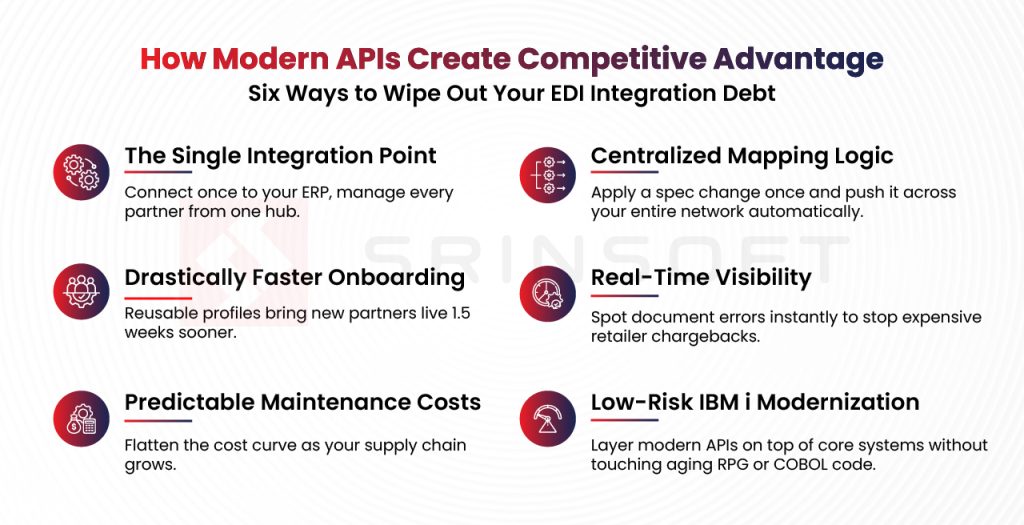
1. The Power of a Single Integration Point
In a traditional EDI setup, every single trading partner gets its own custom connection.
Think about that. Fifty partners means fifty separate connections. Each one has its own custom mapping, its own maintenance cycle, and its own unique failure point.
Modern APIs collapse that chaos.
Your ERP connects just once to the API platform. From there, every single partner relationship is managed from that one centralized point.
For the C-suite, this changes the entire financial conversation. You get smaller IT overhead, fewer failure points, and a much faster time to revenue.
Adding a new partner becomes a quick configuration task instead of a three-week development headache.
2. Centralized Mappings and Automated Updates
What happens in legacy EDI when a major retailer updates their 850 purchase order specification?
Your team has to manually remap the data, run regression tests, and redeploy the connection.
Multiply that across dozens of partners and your IT team wastes most of their week on basic maintenance instead of growing the business.
Modern platforms handle this differently. All of your mapping logic lives in one central location.
When a partner requirement changes, you apply it once. The platform pushes it across your entire network automatically.
This completely eliminates manual rework, regression cycles, and emergency deployments before a go-live.
ALSO READ: How to Manage EDI Data Transformation Pipelines
3. Drastically Faster Partner Onboarding
Traditional EDI onboarding can drag on for weeks or even months.
And let’s be honest. Every week a new supplier or retail partner remains unconnected is a week of lost transaction volume sitting on the table.
The data back this up. IBM’s EDI modernization research shows that organizations achieve 55% faster partner onboarding after moving to a modern platform.
That brings new partners live 1.5 weeks sooner on average.
Modern APIs achieve this speed through reusable partner profiles and pre-built templates for common transaction sets like the 850, 856, and 810.
Automated validation removes manual testing bottlenecks, keeping your cost-per-connection flat as your network scales.
4. Real-Time Visibility Stops Retailer Chargebacks
Legacy EDI is largely invisible until something breaks.
A rejected Advanced Shipping Notice (ASN), a failed transmission, or a massive retailer chargeback penalty usually surfaces hours or days after the fact.
By then, the financial damage is already done.
The supply chain impact is massive because nearly 24% of companies lose $500,000 or more annually to integration issues.
Modern APIs shift this dynamic by introducing transaction-level dashboards. You see exactly where every document sits in the workflow.
Automated alerts flag exceptions the moment they occur, allowing your operations team to prevent fires before they start.
READ MORE: ERP EDI Integration Failure Causes
5. Driving Predictable Maintenance and Lower Long-Term Costs
Integration debt hides on your balance sheet inside wasted IT hours, chargeback penalties, and delayed revenue timelines.
Modern APIs flatten that cost curve. Maintenance overhead shrinks over time rather than compounding with every new partner you add.
Look at Saint-Gobain as a real-world example. They achieved a 92% cost savings per line order after modernizing their EDI processes.
The more partners you add to a single API layer, the more that initial integration investment pays for itself.
6. A Low-Risk Path for IBM i (AS/400) Environments
The IBM i (formerly AS/400) environments are legendary for their reliability.
But they rely on proprietary data formats and require increasingly scarce RPG and COBOL development skills.
Modern APIs resolve this without forcing you to dismantle your foundational systems.
The API layer sits neatly between your IBM i environment and the outside world. It translates proprietary formats, handles core EDI transactions, and connects to modern cloud systems without touching your legacy core code.
For manufacturing and distribution businesses, this is the lowest-risk modernization path with the clearest return on investment.
Must Read: API Vs EDI: Can They Coexist in a Digital Supply Chain
Conclusion
Reducing EDI integration debt is not a one-time project.
It is a strategic decision that shapes how fast your business can move for the next decade.
The enterprises pulling ahead in supply chain today are not the ones with the most trading partners. They are the ones who can onboard a new partner in days, catch a disruption in hours, and scale their network without ballooning their IT overhead.
If you want to start paying down your debt, do these three things right now:
- First, audit your integration landscape. Count your point-to-point connections and measure your average onboarding timeline.
- Second, target the highest-friction connections. The ones that break most often are your highest-return modernization opportunities.
- Third, do not wait for a full system overhaul. Modern APIs are designed to layer onto existing infrastructure, including IBM i (AS/400), without disruption.
The question you should be asking is not whether you can afford to modernize. It is how much the delay is costing your business every single quarter it gets pushed back.
The technology is ready. The path is clear. The only variable left is when you decide to make the move.
Ready to reduce integration debt and future-proof your supply chain?