[ Sep
14-17
] Save the date for inPOWER 2026
[ Sep
14-17
] Save the date for inPOWER 2026
 Email:
inquiry@srinsofttech.com
Email:
inquiry@srinsofttech.com Phone:
+1 614-468-8980
Phone:
+1 614-468-8980







Every legacy system you patch, and every new ERP you add creates hidden friction in your business. When data does not flow smoothly between these systems, you end up with blind spots that cost you money.
Managing a multi-ERP environment is a lot like running a company where everyone speaks a different language. SAP handles finance, Microsoft Dynamics manages sales, and a 15-year-old core system runs your legacy operations. Without a central translator, these departments just end up working in isolated silos.
The biggest risk here is assuming that basic, plug-and-play middleware will automatically fix your data issues. That single assumption is exactly why 84% of multi-ERP integration projects miss the mark.
In this article, we will break down the root data bottlenecks in multi-ERP setups and share practical strategies to help you connect your systems without a risky, expensive replacement.
Integrating data across multiple legacy Enterprise Resource Planning (ERP) systems is highly complex. The primary challenges involve fragmented data definitions, undocumented business logic, and incompatible architectures. Organizations face data silos and duplication that break supply chain visibility and downstream analytics.
What a Multi-ERP and Legacy Environment Actually Looks Like?
When we talk about a multi-ERP environment, we are talking about a company running two or more enterprise resource planning systems at the exact same time. Think of a setup where SAP handles your manufacturing, Oracle runs finance, and Microsoft Dynamics manages sales and CRM.
Organizations do not plan to end up with this kind of mixed environment. Instead, it usually happens naturally over time through a few predictable paths:
Mergers and Acquisitions: Two companies merge, and suddenly IT teams are forced to inherit and stitch together completely different software stacks overnight.
Best-of-Breed Strategies: Different departments choose the absolute best tool for their specific needs, even if those tools do not talk to each other out of the box.
Regional Requirements: International branches adopt specific local software to stay compliant with local tax laws or supply chain regulations.
ALSO READ: ERP EDI Integration Failure Causes
The Real Roadblocks: What Makes This Setup So Difficult?
If you are dealing with a mixed environment, you already know it is a constant uphill battle.
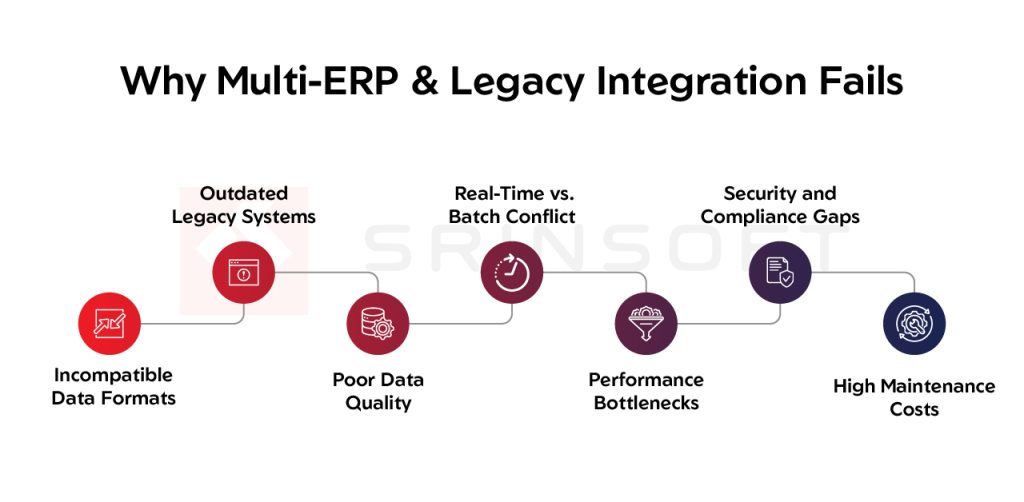
Here are the core problems that make managing multi-ERP and legacy systems such as headaches.
1. Data Silos and Incompatible Formats
Different ERP systems and legacy platforms simply do not speak the same language. For example, one system might structure customer IDs using a specific string of numbers, while another platform uses a completely different format. This leaves you with isolated pockets of information.
To put this in perspective, organizations manage an average of 897 applications, but only 29% of them actually connect properly. The result? You get multiple versions of the truth across different departments. In fact, research from IDC shows that companies lose roughly 20% to 30% of their revenue every single year just from the inefficiencies caused by these silos.
QUICK READ: Integrating ERP with Legacy Systems
2. The Limits of Older Technology
Most legacy systems lack modern APIs. Instead, they rely on outdated protocols or file-based transfers, and many only support batch processing that runs on fixed schedules.
Because these systems are often 15 years old, teams are forced to build expensive custom connectors. This kind of custom legacy work actually swallows up about 65% of an organization’s custom integration budget, costing companies an average of $3.5 million annually.
3. Data Quality and Governance Chaos
When your environment is fragmented, keeping your data clean becomes nearly impossible. You constantly run into duplicate records, missing fields, and conflicting data definitions across systems.
Gartner reports that poor data quality costs organizations an average of $12.9 million per year. Without strong data governance, these errors spread fast and completely ruin your reporting accuracy.
4. The Clash Between Real-Time and Batch Processing
Modern businesses need real-time visibility to make quick decisions but older legacy systems work best with scheduled batch updates. Mixing these two approaches creates a very complicated architecture to monitor.
Real-time integration demands constant infrastructure support and higher costs, while batch processing introduces data delays that slow you down. Trying to balance both usually leads to a messy compromise that satisfies nobody.
5. Scalability and Performance Bottlenecks
As your data volume grows, point-to-point integrations between your multiple ERPs and legacy systems start to slow down and break. Peak business periods expose these weaknesses very quickly. Many of these setups simply cannot handle modern data loads without lagging or failing completely.
6. Security and Compliance Risks
Legacy systems usually run on outdated security standards and miss modern patches. Connecting them to your shiny new ERPs opens new vulnerabilities. This raises your risk of a breach and makes complying with regulations like GDPR or SOX much harder. This is why 43% of IT leaders call security vulnerabilities their top concern with legacy software.
7. Sky-High Costs and Technical Complexity
Building and maintaining custom integrations requires specialized technical skills that are expensive and hard to find. It is a massive financial risk, considering these projects fall short 84% of the time, with average losses hitting $2.5 million per failure. This combination of technical debt and endless maintenance drains your budget and pulls your team away from projects that actually grow the business.
Business Impact of Poor Integration
When your systems cannot communicate, the fallout spreads far beyond IT and directly hurts your bottom line.
First, decision-making grinds to a halt. When financial reporting and forecasting are trapped in different platforms, leaders are forced to make strategic bets based on guesswork.
On the ground, productivity suffers. Teams waste hours manually fixing data and duplicating work across platforms. These silos cost companies an average of $7.8 million annually in lost productivity alone.
Your budget also gets trapped. Instead of funding growth, capital is poured into maintaining fragile custom connectors and fixing failed integration projects.
Eventually, your customers feel the friction through order delays and billing errors. This puts you at a massive competitive disadvantage. In fact, well-integrated organizations achieve a 10.3 times higher ROI on their digital initiatives compared to companies still struggling with fragmented systems.
You Don’t Need an Expensive, High-Risk System Overhaul
You do not need a risky, multi-million-dollar project to rip out and replace your current software. The right approach can stabilize your business operations and unlock your data without messing up your daily revenue.
1. Move from Messy Connections to a Simple Translator
Building direct, messy links between old software and new ERPs creates a nightmare for your IT team to maintain. Instead, successful companies now use a hybrid model with central integration platforms. These platforms act like enterprise translators, turning isolated databases into connected systems that talk to each other in real time.
2. Upgrade Safely by Using a Step-by-Step Approach
To update older systems without risking a massive company-wide crash, use a step-by-step method called the Strangler Fig pattern. Instead of changing everything at once, you gradually move small functions to the cloud while your old, reliable core system continues to run safely in the background. This phased approach has a 76% success rate, while trying to switch everything over on a single weekend fails about half the time.
3. Clean Up Your Data at the Source
When different systems format information differently, your executive reports become highly inaccurate. By setting up a clear master data plan with automated cleaning tools, you create one trusted source for critical details like customer and product IDs. This stops duplicate errors before they spread, ensuring leadership makes big business decisions based on facts, not guesswork.
Closing Thoughts
Managing a mix of old software and multiple ERP systems is tough, but you do not have to accept messy data and slow processes as a normal part of doing business. The answer isn’t an expensive system replacement, and it isn’t relying on basic plug-and-play tools that usually fall short.
The companies that succeed are the ones that actively change how their systems talk to each other. By using a step-by-step approach, protecting your data quality, and connecting your platforms with a central translator, you can stop wasting time and money. This shift protects your budget, makes life easier for your IT team, and finally gives your leadership team the clean, real-time facts they need to make smart strategic moves.
When you look at your current software setup, what is the single biggest bottleneck holding your data back right now?