 [ Sep
14-17
] Save the date for inPOWER 2026
[ Sep
14-17
] Save the date for inPOWER 2026
 Email:
inquiry@srinsofttech.com
Email:
inquiry@srinsofttech.com Phone:
+1 614-468-8980
Phone:
+1 614-468-8980








Every big company reaches the same moment eventually.
They want to move faster and ship more, without waiting six months for a development team to clear its backlog. So, they turn to Low-Code, and for a moment, it feels like the answer they’ve been searching for.
Then someone in the room asks one question that stops the entire conversation.
“But is it actually secure?”
Nobody has a clean answer ready, and you can feel the energy leave the room. The slide gets closed, the project quietly gets shelved, and the team slips back into the same slow habits that got them stuck in the first place. Another good idea dies in a meeting, because nobody could answer one question fast enough.
Here’s what almost nobody in that room realizes. The answer was sitting in front of them the whole time, they just never asked the question the right way.
Why the Myth Exists?
The first wave of Low-Code tools launched around a simple promise: let regular employees build their own apps without waiting on IT.
Nobody centrally managed what got built, where it lived, or who could access it. Naturally, this created real gaps, and those gaps shaped how an entire industry got labeled.
But that was years ago, and the platforms have moved on.
Microsoft Power Platform now ships with Microsoft Entra ID for identity control and built-in data loss prevention policies. Creatio runs on a unified architecture with role-based access baked into every layer. Mendix, OutSystems, and Pega all include centralized environment management, audit trails, and enterprise-grade encryption as standard features, not paid add-ons.
READ MORE: Low-Code Isn’t Replacing Developers. It’s Changing What They Build.
Building the Case
The myth doesn’t survive contact with how modern platforms actually work. Here’s the proof, piece by piece.
Traditional Code Isn’t Automatically Safer
People assume that writing code in Java or .NET makes an application safer than one built visually. That assumption doesn’t hold up once you look at where security actually comes from.
Security is a property of implementation. A skilled team using Node.js can build a rock-solid application. A rushed team using the exact same language can leave holes everywhere. The language never decides the outcome, the discipline behind it does.
Now think about what a custom build actually demands from a development team, every single time:
- Authentication needs to be configured from scratch.
- Authorization logic gets written by hand, screen by screen.
- Logging has to be built into the codebase.
- Audit history requires its own separate implementation.
- API security depends entirely on whichever developer wrote that endpoint.
- Data encryption gets configured project by project.
- Environment management shifts depending on who set it up.
Ten different teams building ten different applications will implement these ten different ways. Some will get it right. Others won’t. And that inconsistency, spread across an entire enterprise, is where real risk lives.
Governance Is Platform-Owned
Enterprise Low-Code flips this entire model. Instead of governance depending on each developer’s judgment, it becomes a property of the platform itself.
Picture the difference in practical terms.
A CISO auditing a traditional environment has to review hundreds of separate codebases, each with its own logic, its own shortcuts, its own blind spots.
A CISO auditing an enterprise Low-Code environment reviews one centralized framework that every application inherits automatically.
One path depends on hundreds of individual decisions going right, one team at a time. The other depends on a single framework being right once, and staying right everywhere it’s used.
Low-Code doesn’t reduce governance. It removes the guesswork from it.
Security by Design
There’s a deeper shift happening here, and it changes how security gets treated from day one.
In traditional development, security is something a developer does. It’s a task on a list, competing for time against feature deadlines and sprint pressure. Build the login screen. Write the password policy. Handle session timeouts. Validate every role. Check every permission. Log every action. Encrypt every field. Secure every API call.
Each item on that list is a chance to get something wrong, and developers are human, under deadline pressure, something eventually slips.
Enterprise Low-Code platforms remove that list entirely. Login, session management, role validation, encryption, and audit logging already exist as platform services before a single screen gets built. The developer’s job shifts from building security to inheriting it.
That’s the real difference. Security stops being an effort someone has to remember. It becomes architecture someone can rely on.
What This Looks Like Inside an Actual HR System?
Think about a typical HR application, and how differently each person inside it should be allowed to move.
- Employees should see their own records, and nothing beyond that.
- Managers should see their direct reports, not the entire company.
- HR staff should update personal details across departments.
- Payroll should reach compensation data that almost nobody else can touch.
- Executives should get a full view across the whole organization.
Five roles. Five different permission levels. One single application holding all of it together.
Here’s where the two approaches split apart.
In a traditional build, a developer writes authorization logic for each role, on each screen, for every API call that touches that data. Add one new screen next month, and someone has to remember to wire in those same rules again, by hand. Miss a single spot, and a payroll field quietly becomes visible to someone who was never supposed to see it.
An enterprise Low-Code platform handles this differently:
- The permission model gets configured once, centrally.
- Every new screen inherits those same rules automatically.
- Nobody has to remember to rebuild the logic from scratch.
What Happens Once You’re Running Hundreds of Apps?
This is usually where the real worry surfaces: “Fine, one application looks manageable. What about the two hundred applications we’ll have in three years?”
Ironically, scale is where enterprise Low-Code platforms perform best. Instead of chasing information through scattered spreadsheets and outdated documentation, a centralized dashboard tracks it all in one place:
- Who created each application, and who currently owns it
- Which environments it lives in
- What data sources and APIs it connects to
- Who’s actively using it, and how often
- Full version history and deployment status
- Audit trails and compliance status, always current
Two hundred apps stop feeling like two hundred separate risks. They start looking like one governed system.
Where Security Problems Actually Come From?
When something does go wrong in a Low-Code environment, the root cause almost always traces back to one of these:
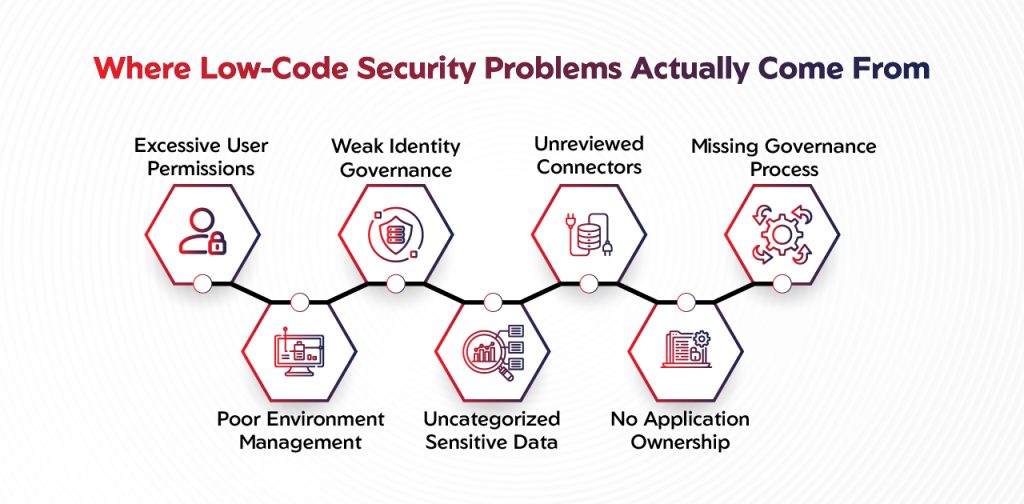
- Users carrying far more permissions than their role actually requires
- Environments that were never properly separated or managed
- Identity governance that nobody assigned clear ownership over
- Data that was never classified, so nobody knew what needed protecting
- Connectors approved once and never reviewed again
- Applications with no clear owner once the original builder moves on
- Governance processes that existed on paper but never got enforced
Notice what’s missing from that list: the platform itself.
Every single item traces back to people, process, and oversight, not technology. And here’s the part worth sitting with: these exact same failures break traditional applications too. The platform was never the weak link. The discipline around it always was.
The Real Question Worth Asking
Most companies never asked whether Low-Code could hold up. They asked whether their own teams knew how to run it right.
That gap between owning good tools and actually using them well, that’s the space we live in.
SrinSoft designs Low-Code applications with governance woven into the architecture, not patched on after launch. Compliance, access control, and audit readiness sit inside the foundation from the first line of configuration, so nothing gets bolted on once the app is already live.
Speed and safety were never opposites. They just needed the same starting point. Give your teams a foundation built for both, and you stop trading one for the other. You get to keep them both, at the same time.